


What Is a Dieline in Packaging? The Small Step That Saves Big Businesses’ Packaging Costs
Discover how premium packaging transforms your brand's perception and drives customer loyalty in today's competitive market.
- What Is a Dieline in Packaging? The Small Step That Saves Big Businesses’ Packaging Costs
- What Is a Packaging Dieline? What You Must Know!
- Why Are Dielines Important? One Step to Avoid Wasting Your Packaging Design Budget
- Creating a Perfect Packaging Die Line: A Step-by-Step Guide
- Upgrade Your Packaging Instantly with Expert Dieline Precision by a Trustworthy Manufacturer
- Understanding the Different Types of Die Lines for Packaging
- Key Benefits of Using Dielines in Product Packaging
- Common Dieline Examples in Creating Trendy & Stylish Enclosures & Printed Packaging
- Top Die-Line Mistakes That Affect Print Quality & Brand Image
- How USA Brands Achieve Perfect Packaging with BoxLark Dieline Solutions
- Final Thoughts!
How does your product perfectly fit inside a box when you look at its packaging? Do you know the foundation of the print-ready packaging file that guides where the design is supposed to be cut, folded, and glued?
As a professional in the packaging and printing industry, you are likely familiar with the often overlooked aspect of packaging. Guess what that is? It’s a dieline. This term sounds fascinating, but it is simple and serves as the backbone for creating innovative packaging designs from scratch.
Whether you are a professional in the packaging sector or a curious creator, you want to know the principles of a dieline. Don’t worry. Stay here. This guide will teach you how to create dielines effectively that can make crafting unforgettable.
Let’s break down the basics of dielines, their categories, and applications to create impactful designs that will win hearts. Don’t miss this; something interesting awaits you in every line!
“Turn Your Packaging into Sales with Powerful Dieline Design”
What Is a Packaging Dieline? What You Must Know!
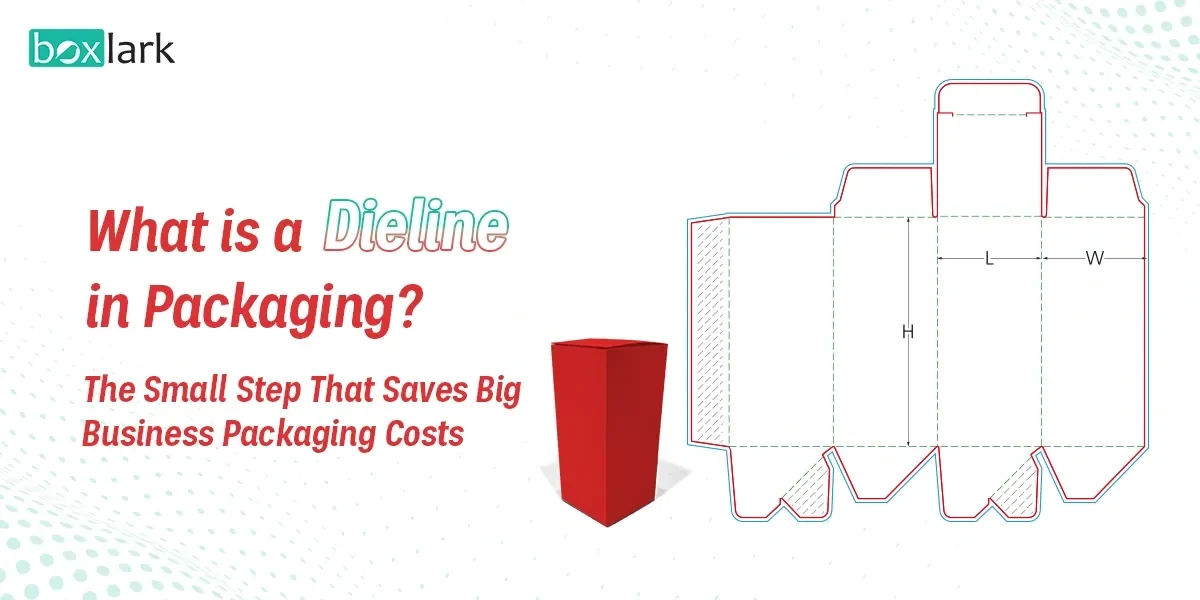
The term “dieline” or “die lines” is also commonly written as two words, such as “dieline” and “die lines.” In custom packaging and printing, a dieline is a design blueprint that defines the precise 2D digital layout of the packaging.
It’s a guide for designers and manufacturers to ensure all visual elements, such as cut lines, fold lines, bleed lines, and safe zones, are marked on its flattened form before production.
By looking at a dieline, you can view all sides of the customized packaging box through its flat structure, format your artwork according to your specific packaging requirements, and see exactly where and how your artwork will be applied.
The dieline is a layout that clearly shows all cut lines and fold marks, making the design process easier and helping create a replica of the packaging; this is our business need. This term is highly specialized and is only understood by packaging professionals or companies that need product packaging.
However, its importance in custom packaging cannot be ignored, as it ensures accurate, precise box dimensions. Designers and manufacturers use the dieline as a guide to fulfill client requirements. It highlights all the cuts and perforations in a flat packaging layout.
The significance of a dieline becomes clear when you need to reproduce an existing packaging box and use it as a model, just like printing companies do. At times, businesses provide a sample box to the printer and request its dieline extraction.
Experts examine the box and evaluate all folds, glue flaps, and lines to ensure the outcome matches the original design exactly.
If you want more information about printing, explore our blog, “What is Die Cutting? Understanding Its Importance, Functions, and Methods”
Why Are Dielines Important? One Step to Avoid Wasting Your Packaging Design Budget
A die line represents the first view of your future packaging product. This element is an integral part of the packaging design process, as it allows a designer to envision the final product and make any necessary adjustments.
Finding Errors and Proofreading:
After printing, packaging materials undergo die-cutting, a process that shapes them into the required forms. Manufacturers use dielines to prepare a custom die board. This involves programming laser machines to engrave the die pattern onto the board, which is then pressed onto the material to create accurate cut shapes.
Moreover, finalizing the die line at this stage is crucial for accuracy. Make your events and gift store products unforgettable with customized die-cut favor boxes created using advanced die-line technology! Thus, customize your designs and themes for a distinctive flair. Place your order today and create an unforgettable experience for your guests.
Prototyping:
Before starting mass production, a packaging prototype is created based on the design patterns, allowing the structure and design to be reviewed and verified.
Creating a Perfect Packaging Die Line: A Step-by-Step Guide
Creating an accurate packaging die line is essential for producing packaging that is both functional and visually appealing.
Below is a step-by-step process to help you design an effective dieline:
Understand Your Product Requirements:
Start by analyzing your product in detail. Consider its dimensions, weight, fragility, and storage conditions. This will help you decide on the packaging type (box, sleeve, pouch, etc.) and the appropriate material. A clear understanding at this stage ensures your packaging design is practical and protective.
Choose the Right Packaging Type and Material:
Choose materials like cardboard, corrugated board, or rigid stock based on your product’s requirements. The choice of material influences durability, print quality, and expense. Ensure your selection meets both practical and branding needs.
Use Professional Design Software:
Use tools like Adobe Illustrator or ArtiosCAD to create your die line. These tools enable exact management of design and organization. Your die line must clearly show:
- Cut lines (where the package will be cut)
- Fold lines (where it will be creased)
- Bleed areas (extra space for printing)
- Glue tabs (for assembly)
Focus on Structural Accuracy:
Make sure all panels fit together well and that folds and flaps work as they should. Small measurement errors can lead to production problems. Creating a physical mockup can be a great way to test the structure before finalizing the design.
Set Up Bleed and Safety Margins:
Include a proper bleed of 3–5 mm to avoid unwanted white edges post-cutting. Ensure vital text and graphics stay within safe margins to avoid being cut off in production.
Prepare Files for Printing and Die-Cutting:
Save your design in the needed format (typically PDF or AI), ensuring layers are clearly marked for cut lines, fold lines, and artwork. Use spot colors to distinguish technical lines from printed elements.
Work with a Trustworthy Packaging Manufacturer:
Choosing a reliable packaging manufacturer is just as important as the design itself. A trusted manufacturer can:
- Review your die line for technical accuracy.
- Suggest improvements for cost-efficiency and durability.
- Ensure high-quality printing and die-cutting
- Provide prototypes or samples before mass production.
Looking for companies that have been around for a while, have good reviews from customers, and can clearly communicate their processes for perfect dieline packaging and printing of products. This prevents expensive mistakes and guarantees your final packaging aligns with expectations.
Always sample your die line before full production. This step identifies design flaws early, paving the way for seamless manufacturing.
“Still Using Wrong Dielines? Fix Your Packaging with BoxLark”
Upgrade Your Packaging Instantly with Expert Dieline Precision by a Trustworthy Manufacturer
A great dieline goes beyond just layout; it shapes the look, feel, and usability of your packaging in a crowded market. BoxLark shines in creating top-notch printed packaging boxes.
A reliable packaging supplier in the USA offers high-quality die-cut solutions for businesses of all sizes using the latest printing techniques and methods. Whatever your packaging needs, our enterprise delivers outstanding results.
We turn simple ideas into expertly crafted packaging, where every cut is sharp, every fold is perfect, and every graphic aligns seamlessly. Whether you want a simple design or a striking, detailed structure, our company in the USA helps you craft custom boxes in any size or shape, ensuring your product shines.
By using top-notch materials and advanced CMYK and PMS printing, your packaging stands out with vibrant, lasting visuals. As your business expands, printed packaging and die-cut boxes offer a budget-friendly way to grow without sacrificing quality. With us, your packaging is not just created; it’s designed to impress, engage, and excel.
Understanding the Different Types of Die Lines for Packaging
The lines consist of three main types of lines:
- Dotted perforation lines
- Cut lines
- Fold lines
When a packaging design is sent for printing, these die lines direct the machine in performing accurate cuts and perforations so the package can be properly folded. Since these elements are treated as separate sets of information for the printer, the perforation and cutting lines appear on different layers and in different colors.
This helps the printer clearly distinguish what needs to be trimmed and what must be folded separately during die-cutting. BoxLark promises to provide very attractive custom-printed packaging boxes, made with laser-cutting and computer-generated designs.
Moreover, our die press works quickly to make your boxes. You can choose any design you like; we will provide the most suitable boxes for your needs. Additionally, safety lines and bleed lines are incorporated to ensure that the artwork remains within the cut or fold boundaries. These processes do not occur simultaneously; instead, perforation is handled in one stage, while cutting is completed in another.
Explore our other blog, “Litho vs Flexo Box Printing: Which is Best for Packaging?”
Key Benefits of Using Dielines in Product Packaging
The dielines let you decide how your final packaging will look. The die-cutting procedure is detailed and can be carried out accurately when all cuts are clearly specified.
It assists in defining the following essential packaging elements:
- Dimensions
- Scaling
- Positioning of logos or text
- Cut lines
- Fold marks
- Bleed areas
- Glue flaps
- Creases
Designers take all these factors into account and, using the dieline as a guide, can produce the most effective physical packaging design.
Additionally, dielines are often used to create packaging for food, beverages, brochures, and other products that require tailored packaging. For more information on the dieline, feel free to ask.
You can further explore our amazing blog on “What is a Dieline in Packaging and Printing? Every Designer and Seller Should Know”
Seeing a preview of your package before the die-cutting stage helps ensure that the layout, colors, sizes, and patterns are just right, giving you the confidence you need.
Additionally, the flat layout provides a full view of the design, making it easier to review and spot potential problems with the design, text, or dimensions early on.
Common Dieline Examples in Creating Trendy & Stylish Enclosures & Printed Packaging
Every box design has different folding lines, closure methods, and dimensional tolerances. Therefore, every box needs an individual dieline to maintain the structure and ensure a precise printing process. Otherwise, a standard die line can be misleading and lead to faulty assembling or even useless packaging.
Here are some examples of high-end, stylish packaging that can be made with the help of a creative dieline process:
Mailer boxes:
Stylish mailer boxes are self-locking containers commonly used for packaging and shipping. They need accurate measurements, as even a millimeter difference in tabs can result in wrong assembly. In addition to correct folds and tab placement, you will need to account for the inward fold allowance and the extra allowance for thick materials, such as corrugated paper or kraft board.
Drawer Boxes:
Slider boxes, matchboxes, and trays have an interior box that slides out from the outer sleeve. Popular package designs for cosmetics, electronics, and pricey items make unwrapping more appealing. The box and sleeve of drawer boxes need separate dielines. While the design should be exactly matched in both sections when closed, measurements are crucial to avoid a tight fit or a loose box.
“Get A Well-Crafted Dieline That Elevates Both Product and Brand”
Rigid Boxes:
Rigid boxes are high-quality packages that do not fold. They are mainly used to store expensive products such as perfumes, devices, or jewels. Their dimensions must be precise since they cannot be altered after manufacture. This box dieline must include wrapping guides, bleeds, turn-ins, and corners cut to avoid paper stretching and bubbles. Avoid noticeable lines by symmetrically expanding the paper.
Tuck-end Boxes:
Many companies in the fast-moving consumer goods (FMCG), pharmaceutical, and cosmetics sectors use tuck-end boxes because they are inexpensive, lightweight cartons. If the dieline is well-designed, the folding and sealing operations may be fully automated. So that glue regions don’t obstruct printing and barcoding, they should provide accurate dimensions for the glue flaps, where to place them, and the order in which to fold them.
Sleeve Boxes:
Stylish sleeve boxes feature a sliding cover that fits snugly over an inner tray holding the products. Box dimensions must maintain proportional measurements as well. A loose fit lets the sleeve slip out, while a tight fit risks cracking them. Accurate circumference calculation based on inner dimensions and material thickness is essential.
Gable Box:
Gable box packaging blends practicality with convenient handles, making it ideal for a wide range of food items, event supplies, and takeaways. It needs to support weight while remaining lightweight and portable. Also, there should be extra support around the fold lines to prevent cracking where the handles meet at the top.
Thus, if you are looking for gable boxes in your area, we provide you with branded boxes according to your expectations. BoxLark’s custom-printed gable boxes and other stylish product packaging are gaining popularity across industries such as bakeries, resorts, and gift shops, as well as in food packaging in the USA. These attractive boxes enhance product presentation and serve as effective branding tools, drawing attention and boosting sales.
Read More: The Art of Selection: 9 Must-Consider Factors for Your Packaging Designer
Top Die-Line Mistakes That Affect Print Quality & Brand Image
Common die-line mistakes that affect print quality and brand image are:
- To save time and money, it is important to avoid several common errors.
- Never ignore the bleed zone to avoid unwanted white borders around your packaging edges.
- To prevent confusion and mistakes during printing and cutting, always keep the dieline simple and clear.
- It is essential to test your dieline with a few prototypes before finalizing it for your product.
- Using RGB instead of CMYK can cause color variations in the final printed output.
- Low-resolution images may appear pixelated or blurred once printed.
- Failing to include a separate die-cut layer can create confusion during production.
- Submitting files in incorrect formats can cause delays and compatibility issues in the printing workflow.
How USA Brands Achieve Perfect Packaging with BoxLark Dieline Solutions
Brands depend on precise dielines to avoid production mistakes, minimize waste, and ensure a uniform appearance across all packaging. Even a minor layout or measurement inaccuracy can lead to printing errors, damaged packaging, or additional expenses. That’s why companies select skilled packaging partners who understand both design and production requirements. BoxLark is the best choice for your product business’s sales. Our dieline & die-cutting process is accurate and affordable thanks to sophisticated technology. Advanced CAD and laser technologies provide error-free packing. This saves time and resources. We provide outstanding die-line packaging. You can contact us by email at sales@boxlark.com or by phone at +1 (800) 811-5541.
Final Thoughts!
A packaging dieline is the foundation of successful custom packaging. Without it, even the best graphic design can not function correctly in production. For packaging buyers, understanding dielines means fewer errors, faster production cost control, and brand presentation. A dieline is far more than a technical layout; it is the foundation of every successful business packaging project. From defining structure and alignment to ensuring print accuracy and production efficiency, a well-prepared die line bridges the gap between creative design and manufacturable packaging, cutting costs & avoiding errors.