


What is a Dieline in Packaging & Printing? Every Designer and Seller Should Know
Discover how premium packaging transforms your brand's perception and drives customer loyalty in today's competitive market.
- What Exactly Is a Dieline in Packaging?
- How a Dieline Transforms Your Idea into Real Packaging and Increases the Value of Your Products!
- Common Types of Dieline Lines for Brand Owners or Designers You Should Know
- Implications of Dielines for Product Packaging
- Why Are Dielines Important for Accurate and Consistent Packaging?
- Why Do You Need a Dieline Before Production Starts?
- Dieline Components: Cuts to Folds Learn Everything
- Dielines in the Printing Process: How Your Packaging Gets Its Shape & Style
- Creating a Dieline? The Essential Step All Designers Follow
- Elevate Your Packaging with Expert Dieline Support
- Why Brands Choose BoxLark for Dieline Packaging in the USA for Their Branded Boxes
- Nutshell!
If you need to deliver your products frequently, you probably understand how important high-quality and visually appealing printed product packaging is. During the design phase, you will encounter the term ‘dieline.’ It plays a crucial role in print and custom packaging design, directing the production workflow.
Moreover, it helps ensure that the final product aligns perfectly with the intended design specifications. But do you know how significant this element really is? In this blog, we will explore everything you need to understand about dieline.
This guide is designed to help designers, sellers, and brand owners improve their stylish packaging game. It includes important information on working with printed packaging manufacturers to achieve perfect dieline techniques in printing and packaging, as well as what to demand from them for business packaging.
I hope you find this blog amazing! Let's get started!
What Exactly Is a Dieline in Packaging?
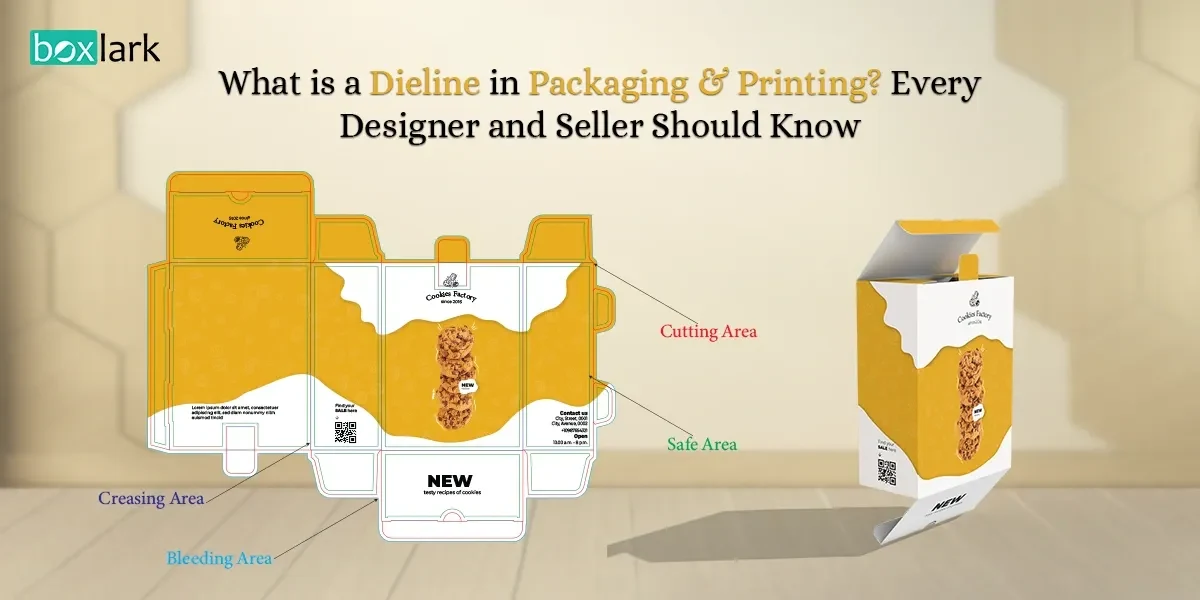
A dieline is a template or a two-dimensional layout. This layout represents the final form and dimensions of a printed item or product packaging. It is developed using specialized tools such as Adobe Illustrator. This element enables designers to create a layout of the product they are working on.
A dieline in packaging serves as a blueprint for a box. Clients tell the designers which areas are required in the box, and the designers create an exact demo in a two-dimensional layout, giving them a look at what their product will look like.
For example, rigid boxes have a firm, durable structure, making cutting and shaping complex. That’s where a dieline comes into play to create any physical form of packaging. A designer or manufacturer begins by developing a 2D layout using tools like Adobe Illustrator or specialized CAD software.
How a Dieline Transforms Your Idea into Real Packaging and Increases the Value of Your Products!
Dielines allow packaging to be designed to minimize material waste. In the packaging industry, every detail must be accurate, so the “dieline” is essential for ensuring that all structural components align perfectly. For instance, product packaging with incorrect cutting or folding may result in an improperly sized box, causing delays and additional costs from rework and relabeling.
Examples of Dieline Precision in Premium Packaging Design:
For food businesses such as bakeries and snack brands, creative logo packaging plays a huge role. An incorrect dieline can cause issues such as misaligned labels or boxes that don’t hold their shape. This not only affects presentation but can also impact hygiene and product safety. A correct dieline ensures the packaging is both functional and attractive.
Another example is a small business that sells skincare products, such as serums and creams. If the dieline is even slightly off, the bottle may not fit properly inside the box, or the printed design could shift onto folds or edges.
This can make the packaging look unprofessional and even damage the product during shipping. Well-designed dielines ensure the box fits perfectly, the branding is aligned, and the product arrives safely and attractively.
Common Types of Dieline Lines for Brand Owners or Designers You Should Know
These are the types of dielines you should print to create the best packaging for your brand:
- Trim Line
- Bleed Line
- Safe Zone Line
- Fold Line
Implications of Dielines for Product Packaging
A dieline acts as a guide that turns a flat design into a real, physical package. It shows exactly where the printed packaging boxes will be cut, folded, and assembled, including technical details like bleed, trim, and safe zones.
It also works as a shared reference between designers, manufacturers, printers, and sellers, making the entire production process smoother and more accurate.
Why Are Dielines Important for Accurate and Consistent Packaging?
Dielines serve as the foundation for the design, printing, trimming, and assembly of your customized merchandise packaging. Without a dieline, a graphic designer, printer, and fulfillment worker wouldn't know where to place design elements and other important product details.
So, when designers use a structured template, they can be sure that all the visual elements are in the right places. This improves the overall design and ensures that colors, logos, and graphics are printed and folded exactly where they belong.
In a market with a lot of competition, even a small difference in color or design can change how people see your brand. Thus, a well-prepared dieline keeps every package looking good and consistent.
"A Professional Packaging Dieline Template Will Make Customers Pause, Unbox, and Fall in Love Time."
Ultimately, dielines ensure that the final packaging is printed consistently using a standardized template that has the precise size and form for your product, leading to improved design quality and usability. The dieline will also consider technical printing factors, such as bleed and specific production requirements.
As a result, your final packaging size, proportions, and measurements will be exactly as required, with all visual elements properly and logically arranged, and structurally strong features such as folds, scores, and glue tabs clearly defined.
If you want to know information about printing methods, you can explore our other blogs, such as "What is foil stamping in printing?" Why is it worth using?" It is a method the packaging industry has used for many years to enhance the visual appeal of packaging and add a premium touch to every box.
Why Do You Need a Dieline Before Production Starts?
Before sending any packaging design to print, a dieline helps you avoid costly mistakes and ensures everything is ready for manufacturing.
Accurate Size and Proper Design Placement
A dieline provides exact measurements for every panel, fold, and flap. This ensures your design fits perfectly and that nothing important is misplaced or cut off during printing.
Fewer Errors and Rework
A dieline allows designers to review mockups and address issues such as layout, text placement, and structure early on. This lowers the likelihood of production errors, saving time and money.
Dieline Components: Cuts to Folds Learn Everything
To understand a dieline, you first need to recognize the purpose of the different lines and colors, which show where to cut, fold, and glue your packaging.
Here are some components of the dieline:
Cut Lines: (Trim Black Line)
Cut lines are displayed as black outlines, indicating where the cutter will trim the flat sheet to create the final physical shape. These guides help ensure accurate cutting and proper layout before the production stage.
If you are looking for wholesale printed die-cut packaging boxes, BoxLark offers you stunning custom boxes with dieline techniques. We use lasers and computer-based methods to create the designs. Moreover, our die press operates quickly, enabling us to produce your boxes. We can also print and finish them the way you want.
Fold Lines: (Crease Red Line)
Fold lines are shown in red, indicating where the material should be lightly scored and folded to form the package's 3D structure. We use Computer-Aided Design (CAD) software and laser technology to produce error-free packaging. Subsequently, we save time and resources.
Bleed Lines: (Black Line)
Bleed lines, also marked in black, define the area that extends beyond the print boundary. This allows background colors and images to go past the trim edge, avoiding unwanted white borders if there is slight shifting during cutting.
Safe Zone: (Blue Dotted Line)
Safe zone lines, usually shown in blue or green, mark the secure area for placing design elements like logos, text, and graphics. Keeping content within this zone prevents it from being trimmed or obscured.
Glue Tabs:
Glue tabs, often indicated with a criss-cross pattern, show where adhesive will be applied to hold the package together in its final assembled form.
You can choose our eco-friendly packaging. The full CMYK printing process produces bright, lively images and colors, which are essential for attracting people. It compels your clients to purchase your products.
Dielines in the Printing Process: How Your Packaging Gets Its Shape & Style
During production, dielines are used to create essentially custom cutting dies, oversized cookie cutters that enable your packaging manufacturer to produce large quantities of your unique packaging while maintaining uniformity.
They are constructed from wood and metal and are then mounted onto the rollers of the converting machines. The machines your packaging partner uses in production will trim the flat, pre-folded, and pre-sealed version of your packaging exactly as specified by the dieline.
Dielines are also employed to create print plates that transfer your custom packaging artwork and graphics. These function like giant stamp pads, mounted on the rollers of the converting machines to imprint the design onto your packaging. Once again, all of these steps are guided by the original dieline's blueprint.
Do not stop reading!
Creating a Dieline? The Essential Step All Designers Follow
Making a dieline from scratch can be challenging for designers or business owners wanting to experiment before consulting a professional.
To create a dieline on your own: Find any box nearby, unfold it, trace the outline, and feel the flaps and creases. Measure these with a scale to guide your design.
Next, use software like Adobe Illustrator to draw precise cut lines, add layers, and insert your artwork, setting the dieline stroke to "Overprint Stroke.'
Alternatively, measure the dimensions of a similar box and use them in a design tool like Illustrator to create your dieline.
“BoxLark Dielines: The Smart Way to Perfect Packaging”
Elevate Your Packaging with Expert Dieline Support
A well-prepared dieline is not just a technical file; it directly affects how your packaging looks, feels, and performs in the market. From accurate cuts to perfectly aligned graphics, every detail depends on how well the dieline is created.
At BoxLark, we focus on precision at every stage. Our dieline process ensures your packaging is printed with accurate color placement, clean folds, and a professional finish. Whether you use CMYK or Pantone colors, proper dieline setup helps maintain consistency across every unit.
We also design packaging structures that are practical and easy to assemble while delivering a strong visual impact. From die-cut shapes to functional layouts, every element is planned to improve both presentation and usability.
Why Brands Choose BoxLark for Dieline Packaging in the USA for Their Branded Boxes
Brands rely on accurate dielines to prevent production errors, reduce waste, and maintain a consistent look across all packaging. Even a small layout or measurement error can lead to misprints, damaged boxes, or additional costs.
With the right dieline approach:
- Your packaging fits the product perfectly
- Your design stays aligned after printing and folding
- Your production process runs smoothly
That’s why businesses choose experienced packaging partners who understand both design and production requirements. For this, BoxLark is the best option near you. You can contact us by email at sales@boxlark.com or by phone at +1 (800) 811-5541.
Nutshell!
You can't print, fold, cut, or assemble a product box without a dieline, a crucial 2D design tool in the packaging and printing industries. Properly arranging design elements such as logos, text, and colors within the designated safe, bleed, and trim zones can lessen production errors. Brands and sellers benefit from consistent, aesthetically pleasing, and functional packaging, and designers get a roadmap for arranging artwork properly. Using dielines helps keep production running smoothly, reduces waste, and maintains high-quality standards for the brand. They transform new packaging ideas into precise, visually appealing designs ready for production.