


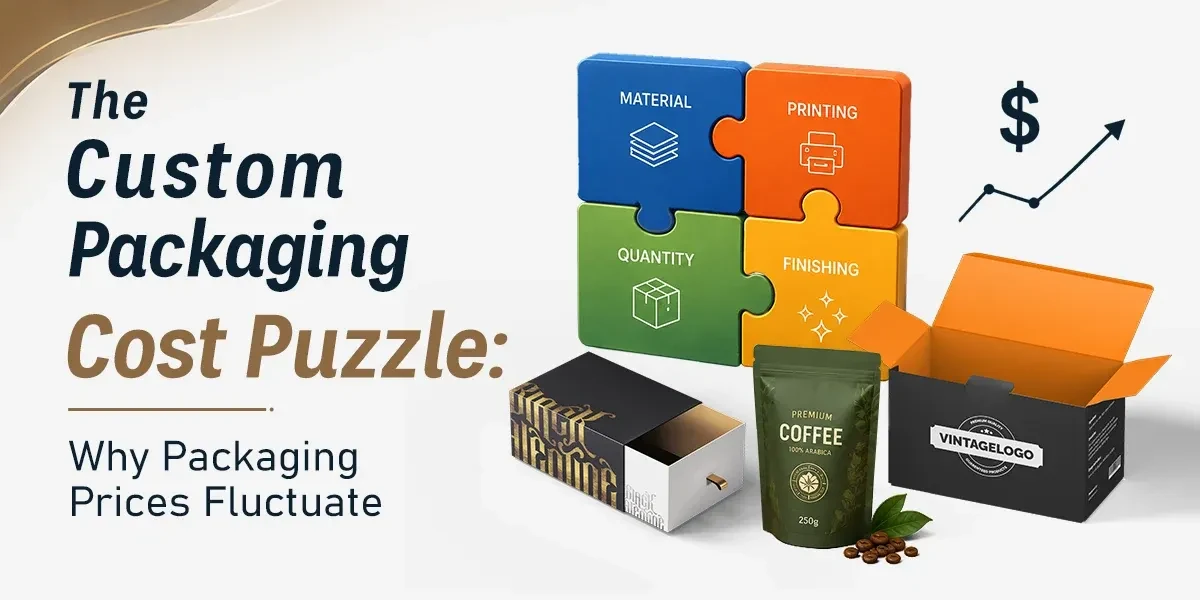
The Custom Packaging Cost Puzzle: Why Packaging Prices Fluctuate
Discover how premium packaging transforms your brand's perception and drives customer loyalty in today's competitive market.
- Key Takeaways
- What Factors Are Taken into Account When Determining Custom Packaging Expenses?
- How Does Material Choice Affect Custom Packaging Costs?
- How Do Packaging Size and Dimensions Affect Custom Packaging Costs?
- How Do Design Complexity & Box Structure Change Packaging Costs?
- Printing Methods: Why They Influence Custom Packaging Costs
- Finishing Options: How Extra Details Increase Packaging Costs
- Production and Assembly: The Labor Behind Packaging Costs
- Additional Services: The Extra Details Behind Packaging Costs
- Economies of Scale: How Order Quantity Affects Packaging Prices
- How to Reduce Custom Packaging Costs Without Compromising Quality
- What Role Does a Packaging Manufacturer Play in Pricing?
- Closing Remarks!
Custom packaging prices can vary due to several factors, making it challenging for businesses to predict their packaging costs. A packaging quote may fit your budget today, but tomorrow, the same requirements may come with a different price. The cost of custom packaging depends on multiple elements, including the type of material used, box style, design complexity, printing methods, order quantity, finishing options, and manufacturing processes.
Furthermore, some businesses can also influence packaging costs through their own decisions.
"Small decisions can create big cost differences"
Placing large order quantities usually helps reduce the cost per unit, while small orders, complex designs, premium finishes, or urgent production timelines may increase expenses.
"Every package has a story beyond its price tag!"
Understanding all these cost factors helps businesses make smarter packaging decisions and create a balance between quality, budget, and brand presentation.
In this blog, we’ll look at the key factors that drive fluctuations in custom packaging prices, which ones you can control, and practical ways to plan your budget without sacrificing quality or brand image.
Without any delays, let’s begin!
Key Takeaways
- Custom packaging prices fluctuate because of changing market conditions and packaging requirements.
- Material choice, packaging size, structure, printing, and finishing all influence the final cost.
- Order quantity can significantly reduce the cost per packaging unit through economies of scale.
- Additional services, such as prototypes and custom design support, may increase the overall quote.
- Understanding these pricing factors helps businesses estimate budgets more accurately.
What Factors Are Taken into Account When Determining Custom Packaging Expenses?
Custom packaging costs are calculated by combining different elements involved in creating and delivering the final package. Although each project has distinct needs, the majority of pricing choices depend on several key factors that affect the total custom packaging cost. A simple way to understand the calculation is:
Cost of Custom Packaging = Material + Design + Printing + Finishing + Manufacturing + Shipping + Extra Services
Each component contributes to the final quote differently. Let’s take a quick overview of these cost breakdown factors and understand what each one includes.
Cost Factor | What It Includes | How It Affects Cost |
Materials | Paperboard, cardboard, kraft paper, corrugated board, rigid board, flexible packaging films, specialty papers, and protective materials | Material type, thickness, and quality influence the overall price |
Design and Structure | Box style, dimensions, custom shapes, windows, inserts, and structural features | Complex designs require more planning and production work |
Printing | Printing artwork, logos, brand names, and other design elements | More detailed designs and advanced printing techniques can increase costs |
Finishing | Coatings, laminations, foil stamping, and embossing | Additional decorative features add extra processing steps |
Production | Manufacturing, labor, assembly, and quality checks | Complex production requirements can increase processing time and expenses |
Shipping | Package weight, size, delivery method, and destination | Larger or heavier packages may result in higher transportation costs |
Additional Services | Prototypes, samples, design assistance, and special requests | Extra services add to the overall packaging investment |
These factors set the foundation of every packaging quote. In the following sections, we will explore each element in detail and understand how it influences the final custom packaging prices.
How Does Material Choice Affect Custom Packaging Costs?
A study indicates that packaging materials generally constitute approximately 3% to 15% of a product’s overall expenses. However, the final cost can vary significantly depending on the packaging type selected.
A simple paper bag, folding carton, or premium rigid box may all serve the same purpose, yet their costs can differ significantly due to variations in quality, durability, and production requirements.
Some materials are ideal for budget-friendly packaging, while others are selected to create a more premium presentation.
The table below gives a summary of typical packaging materials and their impact on cost:
Packaging Material | Common Uses | Cost Impact |
Kraft Paper | Shopping bags, food packaging, bakery bags | Budget-friendly option |
Cardboard | Affordable and versatile | |
Paperboard | Cosmetic boxes, folding cartons, food boxes | Cost-effective with excellent printability |
Bux Board | Cosmetic boxes, medicine cartons, food cartons | Mid-range option with good strength |
Chipboard | Inserts, gift boxes, lightweight packaging | Low-cost support material |
Corrugated Board | Shipping boxes, e-commerce packaging | Higher cost for added protection |
Rigid Board | Higher cost for premium appearance | |
Flexible Films | Mylar bags, sachets, stand-up pouches | Cost varies depending on film type, thickness, and barrier properties |
Selecting the right material requires careful consideration of product requirements, brand image, and your budget. By making a suitable choice, companies can prevent excess costs, minimize material waste, and create excellent packaging.
How Do Packaging Size and Dimensions Affect Custom Packaging Costs?
Packaging doesn't become costly just because of its size, but because every extra inch adds to the resources required to produce, store, and deliver it. Whether it's a box, paper bag, or wrap, dimensions directly influence material usage, production requirements, storage space, and shipping costs.
Larger Packaging Size = More Material + More Space + Higher Transportation Cost
For example, if a product fits into an 8 × 6 × 4 inch box but is packed in a 16 × 12 × 8 inch box, it requires more material, more cutting area, and may need additional fillers to prevent product movement.
Businesses should also consider:
- Material consumption: Larger-sized packaging requires more paperboard, cardboard, or corrugated stock.
- Shipping volume: Oversized packaging takes up more space and may increase delivery costs.
- Storage needs: Bigger boxes require more warehouse space before reaching customers.
Choosing the right dimensions is not about making the smallest box or bag possible. It is about avoiding unnecessary space that quietly increases packaging expenses.
How Do Design Complexity & Box Structure Change Packaging Costs?
The structure of a custom box or a retail bag can change its price significantly. Even when two boxes use similar materials, their costs may vary because the design determines how much material, processing, and labor are required during production.
Some packaging formats follow a simple manufacturing process, while others require additional components and assembly. For example, premium styles like custom 2 piece boxes and magnetic boxes involve more production work than standard folding cartons.
Factor | 2 Piece Box | Magnetic Box |
Structure | Separate lid and base | Rigid box with magnetic flap |
Production | Moderate assembly | Higher assembly and alignment |
Cost | Premium | Very High (Luxury Premium) |
Selecting a packaging structure that suits your product, branding, and budget helps manage custom packaging prices without adding unnecessary production costs.
Printing Methods: Why They Influence Custom Packaging Costs
Printing costs are not only about adding colors to the plain brown packaging. The final price depends on the printing method, color system, artwork requirements, setup process, and order quantity.
Moreover, the color system also affects pricing. CMYK printing uses four standard colors to create a wide range of shades, while PMS printing uses pre-mixed colors for more accurate brand matching and may require additional preparation.
Printing Method | Suitable Quantity | Cost Impact | Best For |
Digital Printing | 50 to 500 units | Lower setup cost but higher cost per box at large volumes | Small batches and prototypes |
Offset Printing | 500+ units | Higher setup cost but lower unit cost for bulk orders | Retail and premium packaging |
Flexographic Printing | Large production runs | Efficient for high-volume orders | Shipping and large-scale packaging |
Laser Printing | Small quantities | Low setup cost, higher cost for large volumes | Short runs, prototypes, personalized packaging, barcodes, and variable data printing |
The best printing method is not always the most expensive one. Matching the technique with order size, design needs, and budget helps businesses avoid unnecessary printing expenses.
Finishing Options: How Extra Details Increase Packaging Costs
Finishing options can change packaging costs because each technique adds another layer to the production process. The final price depends on the materials required, setup involved, application method, and the area covered.
Finishing Option | What Adds to the Cost | Production Requirement |
Foil Stamping | Foil material, tooling, and setup | Requires precise application and separate processing |
Embossing/Debossing | Custom dies and preparation | Needs pressing equipment and accurate alignment |
Spot Gloss UV | Additional coating material and setup | Requires selective application on specific areas |
Soft Touch Lamination | Specialized lamination film | Needs an extra lamination stage |
Metallic Coating | Special metallic coating or metallic ink | Requires an additional coating or printing process |
Aqueous/Varnish Coating | Coating material and processing | Adds a protective finishing stage |
For example, a box with only standard coating requires fewer production steps than a package with foil stamping, embossing, and soft-touch lamination. Selecting finishes strategically helps businesses achieve the desired look while avoiding unnecessary increases in costs.
Production and Assembly: The Labor Behind Packaging Costs
The manufacturing process behind custom packaging also influences its final price. Even packaging made with the same material and design can have different costs depending on machine work, labor requirements, and assembly time.
Production costs usually increase when packaging requires:
- More assembly time: Folding, gluing, wrapping, or installing components requires additional labor.
- Complex manufacturing steps: Special cuts, multiple parts, and detailed structures need more processing time.
- Quality checks: Premium packaging often requires extra inspection to maintain consistency.
Production Type | Cost Difference | Example Packaging |
Machine-based production | Lower labor cost due to faster processing | Folding cartons and packaging sleeves |
Partial manual assembly | Moderate increase due to additional handling | Boxes with inserts, paper bags with handles, or packaging with special decorative elements |
Fully manual assembly | Higher cost due to increased labor time | Rigid boxes and luxury packaging |
For example, a straight tuck box can move through production with fewer steps, while a rigid box may require wrapping, alignment, and manual assembly. Similarly, shopping bags with handles, reinforced structures, or special finishes may need additional labor during production. These additional processes increase manufacturing time and contribute to a higher packaging cost.
Additional Services: The Extra Details Behind Packaging Costs
Beyond the basic manufacturing process, additional services and custom requirements can also influence the final packaging price. These elements are often added to improve the appearance, functionality, or overall customer experience, but they require extra materials, labor, or processing.
Common additional cost factors include:
Additional Service | How It Affects Cost |
Custom finishes | Special materials such as leather, suede, velvet, or textured finishes require additional material and application processes |
Prototypes and samples | Adds testing, revisions, and preparation costs before bulk production |
Design assistance | Requires extra planning and adjustments to finalize the packaging structure and artwork |
Shipping can also influence the final quote, especially for oversized, heavy, or international orders. Package dimensions, weight, and delivery distance can increase transportation expenses.
Considering these additional requirements early helps businesses create a more accurate packaging budget and avoid unexpected cost increases.
Economies of Scale: How Order Quantity Affects Packaging Prices
The number of packaging units you order directly affects the price per unit. Packaging production involves setup expenses, such as machine preparation, plate creation, and tooling, which are spread across the total quantity produced.
For example:
Setup Cost: $500
500 boxes:
$500 ÷ 500 = $1 setup cost per unit
10,000 boxes:
$500 ÷ 10,000 = $0.05 setup cost per unit
This is why larger orders usually have a lower cost per piece, even when the total investment is higher.
Order Quantity | Cost Effect | Suitable For |
Small quantities | Higher cost per unit due to setup costs being divided among fewer pieces | Samples, testing, limited launches |
Medium quantities | Balanced pricing with better unit rates | Growing brands and regular production |
Large quantities | Lower cost per unit through bulk production efficiency | Established brands and high-volume orders |
However, ordering more units is not always the cheapest choice. Excess inventory can increase storage costs and create waste if packaging requirements change.
A balance between unit cost and inventory requirements helps businesses manage packaging expenses effectively.
How to Reduce Custom Packaging Costs Without Compromising Quality
Reducing packaging expenses does not always mean choosing lower-quality options. Small adjustments in materials, design, and production choices can help businesses manage their custom packaging cost while maintaining quality.
Businesses can reduce costs by:
- Choose suitable materials: Match the material to your product instead of selecting premium options unnecessarily.
- Optimize box dimensions: Right-sized packaging reduces material, storage, and shipping costs.
- Order strategically: Larger orders can reduce unit costs, but avoid excess inventory.
- Limit premium finishes: Apply special finishes only where they add the most value.
- Work with an experienced manufacturer: Expert guidance can help avoid costly production mistakes.
Making informed decisions throughout the packaging process helps businesses find affordable custom packaging solutions without compromising functionality or appearance.
What Role Does a Packaging Manufacturer Play in Pricing?
Custom packaging costs can vary between manufacturers, even for similar designs. Factors such as material sourcing, production capabilities, equipment, labor costs, and pricing structures influence the final quote. That is why working with an experienced manufacturer who understands how to balance design requirements, production methods, and budget limitations is important.
BoxLark helps brands create solutions that match their budget and brand identity. Our expertise and support allow businesses to make smarter choices in materials, designs, and production while maintaining high standards.
Closing Remarks!
Custom packaging costs are shaped by multiple decisions made throughout the process. Material selection, packaging dimensions, structure, printing, finishing, production requirements, order quantity, and additional services all contribute to the final quote.
A small change in one area can influence the overall cost. Larger packaging may require more material and increase shipping expenses, while a complex structure or premium finish may add extra production steps. Understanding these factors helps businesses make smarter choices and avoid unnecessary expenses.
The goal is not always to choose the cheapest packaging option. It is about finding the right balance between cost, quality, functionality, and brand presentation. By selecting suitable options and working with a reliable packaging partner, businesses can create packaging that meets their needs while staying within budget.