


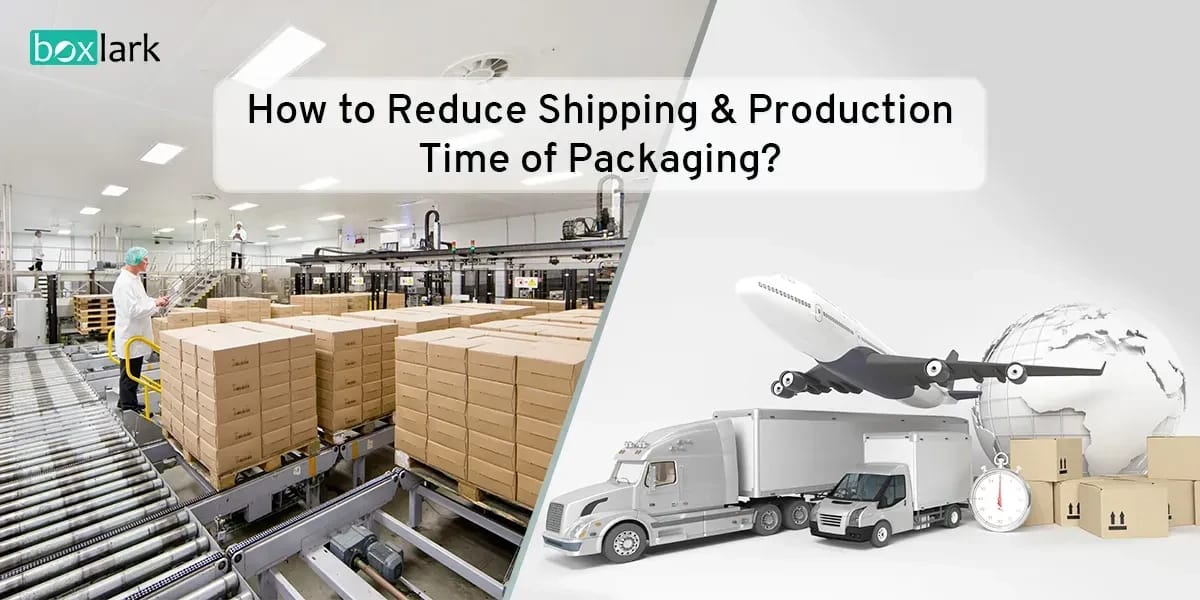
How to Reduce Shipping & Production Time of Packaging?
Discover how premium packaging transforms your brand's perception and drives customer loyalty in today's competitive market.
- Production Time: Definition and Importance
- What is the Shipping Time of Custom Printed Packaging?
- Managing Every Step of Production and Delivery in the Supply Chain
- Critical Analysis of Packaging Production and Shipping Delays
- Learn How the Product Packaging Process Works
- Smart Strategies to Reduce Packaging Production and Shipping Time
- Pros of Optimizing Packaging Production and Shipping Time
- Final Insights!
When we talk about packaging, we don’t just limit it to the outer covering of the product. In the backend, there lies a complete process that requires a lot of time and effort, and goes through multiple stages to reach completion and get delivered. It starts from the initial consultation to material selection and other similar processes.
Businesses with efficient packaging processes have a prominent advantage in today’s retail and e-commerce market. Customers expect their products to be delivered as quickly as possible. This ultimately depends upon the packaging companies, as delayed production and deliveries lead to higher costs and unhappy customers.
In this blog, we will discuss simple yet smart strategies to reduce the production and shipping time that lead to satisfied customers. But before that, let us understand what production time and shipping time are!
Production Time: Definition and Importance
The time period required to manufacture a product from start to finish is called the production time. It involves the complete process of manufacturing custom boxes, including consultation, digital design creation, printing, cutting, finishing, creasing, assembling, and testing of the packaging before it reaches you.
What is the Shipping Time of Custom Printed Packaging?
The time a completed order takes to reach the business or end customer from the manufacturer or the supplier is called the shipping time. It includes transportation, handling, customs (for international deliveries), delays caused by the logistics, and delivery.
Here's a thing we need to understand first. There is a huge difference between the local and international delivery timelines.
Domestic Delivery | International Delivery |
1. Shipping takes place within the same country. | 1. Shipping takes place between different countries. |
2. Delivery time is usually shorter and does not require customs clearance. | 2. Delivery time is usually longer, and shipments must go through customs clearance. |
3. Fewer shipping rules and procedures are involved. | 3. More shipping rules, documentation, and logistics are involved. |
Now, let's move forward to the understanding of the factors that are the primary causes of the delays that can affect the entire packaging procedure.
Managing Every Step of Production and Delivery in the Supply Chain
Shipping from Supplier to Manufacturer
- This is when materials are being sent to the packaging company.
- Example: A packaging company orders cardboard, inks, or other materials from its suppliers.
- Delays here can be caused by supplier issues, long distances, customs (if international), or material shortages.
- Solution: Use local suppliers or maintain buffer stock to avoid stopping production.
Shipping from Manufacturer to Brand (B2B Delivery)
- This is when the finished packaging is delivered to the client.
- Example: A packaging company ships custom printed boxes to a brand that placed an order.
- Delays here affect the company’s production schedule, order fulfillment, or product launch.
- Solution: Plan shipping routes, use reliable couriers, and offer rush delivery options.
Critical Analysis of Packaging Production and Shipping Delays
Despite careful planning, many businesses face delays in packaging production and shipping. Let us take a closer look at the critical bottlenecks to reveal why these slowdowns occur and how they impact the supply chain.
1. Complex Packaging Designs
When you opt for complex designs and detailed graphics, it requires more steps and attention to manufacture as compared to the simple ones. These may take a long time to cut, assemble, and handle. It might also require additional setups and multiple quality checks, which can also lead to the risk of errors and rejection of batches.
2. Unavailability of Certain Materials
One of the major roadblocks to delays is when the manufacturing company becomes short on essential materials. If the company runs out of materials such as kraft, cardboard, etc., it can push back the entire schedule. These shortages happen because of poor inventory planning, supplier issues, and sudden spikes in demand.
3. Poor Coordination with Supplier
Communication between the supplier and the manufacturer plays a significant role, as unclear communication or order forecasts are not shared, the supplier may fail to provide the materials on time. Sometimes businesses rely on multiple vendors for different materials, so a delay from one vendor can disrupt the whole timeline.
4. Long Transportation Routes
This can drastically increase the shipping time and prove to be a bottleneck in the packaging supply chain. When you send custom product boxes from distant or overseas, it can take more time and therefore result in late deliveries or unexpected costs.
5. Lack of Automation
In the world of advancing technology, relying on manual processes for cutting, assembling, or printing can be prone to mistakes and rejected batches. This adds to the time consumption and inconsistency in the batches.
Learn How the Product Packaging Process Works
By understanding the whole packaging process, a business can get a better idea of how the production and shipping of goods work from start to end. This way, they can identify the areas where a delay may occur. These are some important steps involved in the production of the packaging.
- Design and Artwork
- Material Selection
- Printing and Manufacturing
- Quality Control
- Storage and Handling
- Shipping and Delivery
Smart Strategies to Reduce Packaging Production and Shipping Time
After identifying the key challenges in the production and shipping of the packaging and understanding the complete workflow, the business should take the following practical steps to minimize the delays. When businesses implement these smart strategies, it helps them improve their coordination with the supplier, speed up the manufacturing process, and ensure on-time delivery. On top of this, both production and logistics become smooth to operate and help them meet supply chain and customer expectations.
Let us take a detailed look at the practical and effective strategies:
1. Optimize Packaging Designs for Production
Designs should be planned with production efficiency in mind. Designers can reduce unnecessary layers, limit excessive printing techniques, and use standardized die lines, ultimately allowing brands to maintain visual appeal while avoiding unnecessary production delays.
2. Maintain Adequate Material Inventory
It is important to keep the essential packaging stuff, such as cardboard, inks, and coatings, in stock to prevent production from stopping due to shortages and ensure smoother operations.
3. Improve Supplier Coordination
Clear communication and strong relationships with suppliers help ensure that materials arrive on time and production schedules remain stable.
4. Speed Up Workflow and Approvals
Cutting extra approval steps and organizing tasks well can speed up production and reduce delays.
5. Use Accessible or Fast Suppliers
Working with nearby suppliers or choosing faster transportation options can reduce shipping time and lower the risk of delivery delays.
6. Advanced Production Processes
Advanced tools and machinery can increase production speed, reduce manual errors, and improve overall efficiency.
7. Ready for Sudden Order Demands
Flexible production planning helps businesses handle sudden increases in orders without slowing down packaging production.
8. Optimize Shipping and Logistics Planning
Improving route planning, warehouse coordination, and delivery management helps ensure that packaging reaches its destination quickly and efficiently.
Note: Take into account that delays and unforeseen challenges may arise in any business, but they must be occasional and not a regular occurrence. Delays may put a business’s reputation at stake and may raise questions from clients about a business’s reliability. Businesses that manage delays in a smart way appear more reliable and professional to their clients.
Pros of Optimizing Packaging Production and Shipping Time
Reducing production and shipping delays brings multiple advantages to a business. The following are the major advantages a business can gain when it applies effective strategies to its packaging process.
- Faster order fulfillment and delivery
- Lower operational and storage costs
- Improved customer satisfaction and trust
- Stronger brand reputation and reliability
- Smoother supply chain with minimum bottlenecks
- Reduced risk of damaged or lost products
- Better inventory management and planning
- More flexibility to handle sudden demand spikes
- Higher employee efficiency and reduced overtime
Final Insights!
Efficient packaging production and transportation are the keys to a smooth supply chain with satisfied customers and a positive brand reputation. Delays in production, shortage of materials, and poor workflow may lead to serious consequences and dissatisfied customers. With the implementation of smart strategies, a business may avoid delays!
It is recommended that you seek a reliable and experienced packaging company that has a high reputation and quality standards in delivering packaging solutions in a timely manner. BoxLark, a top-class packaging production company, provides a standard turnaround time of 8-10 days and rush orders within a period of 4-6 days.
So, are you ready to get associated with a company that delivers professionalism, reliability, and quality packaging? Just drop us a message at sales@boxlark.com.