


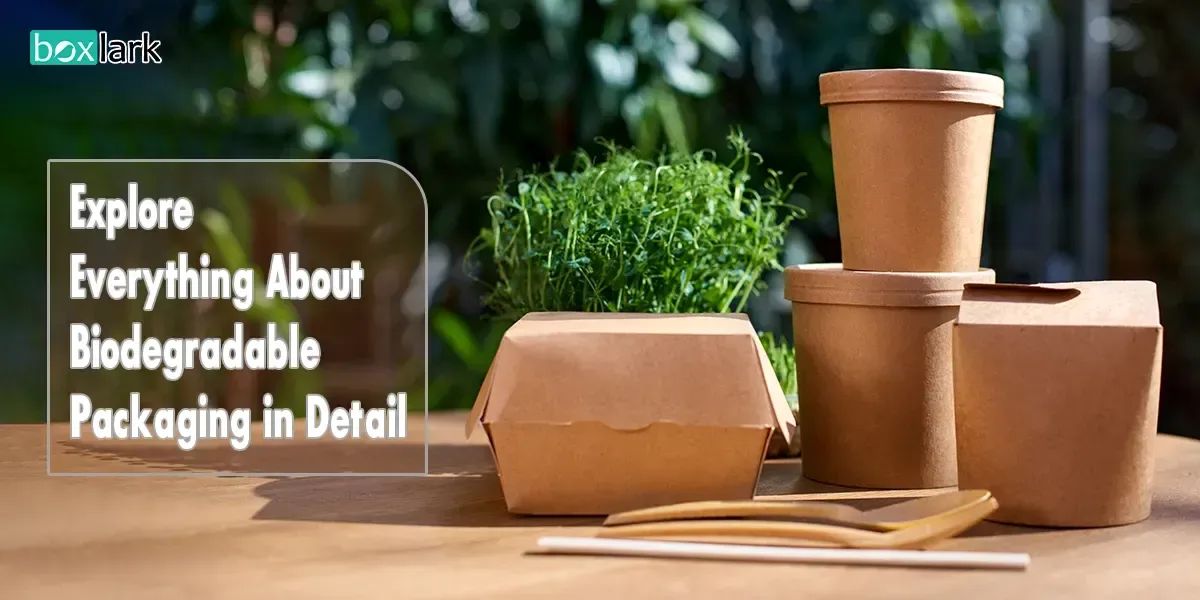
Explore Everything About Biodegradable Packaging in Detail
Discover how premium packaging transforms your brand's perception and drives customer loyalty in today's competitive market.
- 1The Increasing Practice of Biodegradable Packaging Among Businesses and Consumers
- Definition and Working of Biodegradable Packaging Materials
- Understanding the Difference Between Biodegradable, Eco-Friendly, and Sustainable Packaging
- Key Biodegradable Materials and Their Applications in the Packaging Industry
- How to Identify Whether Packaging Is Truly Biodegradable
- Key Advantages and Drawbacks of Biodegradable Wrapping Solutions
- Industry Growth and Increasing Consumer Demand for Biodegradable Packaging
- Cost Challenges and Long-Term Benefits of Packaging Made from Renewable Materials
- Closing Remarks!
The role of packaging is no longer limited to just protecting goods during storage or transport. Now it is a direct association with the consumption of the resource, along with its effects on the environment. As the level of concern for environmental pollution and global warming continues to increase with every passing day, people are becoming more aware of the environmental impacts of materials that are used in packaging. In this regard, biodegradable packaging has gained significant attention among many packaging options that are currently available in the market. These materials have the ability to decompose naturally with the passage of time, unlike the plastic packaging materials that end up in landfills. Thus, it can be said that biodegradable packing is a promising solution for secure packing and eco-friendliness.
This blog covers all the information you need to know about biodegradable packages, such as the materials used, the pros and cons, the current market trend, cost-effectiveness, and so on.
Keep on reading to learn about some of the most interesting facts about biodegradable wrapping!
The Increasing Practice of Biodegradable Packaging Among Businesses and Consumers
One of the environmental issues that has been a concern in recent times is packaging waste. A significant portion of daily waste is attributed to packaging materials. Most of this packaging is made of plastics, which take up to hundreds of years to disintegrate, thereby leading to land and water pollution. This calls for reviewing the packaging materials that are commonly used today.
The use of biodegradable materials reduces the packaging waste, which is likely to reduce the negative impact on the environment. This is because they are easy to decompose with the help of microorganisms, and therefore, they do not stay in the environment, unlike conventional plastics. Biodegradable materials are likely to help many industries reduce their carbon footprint while meeting the expectations of customers who prefer eco-friendly packaging.
However, the environmental benefits depend on how the packaging is produced and disposed of. This means that even if a material is biodegradable, it may not break down properly without a good recycling system.
Definition and Working of Biodegradable Packaging Materials
Biodegradable packaging is that which can break down into simpler substances through biological processes. This happens with living organisms that include bacteria, fungi, and other substances present in the environment. With time, the packaging materials decompose into water, carbon dioxide, and biomass, leaving little to no harmful residue.
It is important to note that biodegradable does not mean that packaging materials will break down instantly. Some materials might require controlled conditions to decompose.
Understanding the Difference Between Biodegradable, Eco-Friendly, and Sustainable Packaging
Terms like biodegradable, eco-friendly, and sustainable packaging are often used together, but they refer to different aspects of environmentally friendly packaging.
Terms | Biodegradable Packaging | Sustainable Packaging | Eco-Friendly Packaging |
Definition | Biodegradable packaging includes materials that break down into natural substances such as water, carbon dioxide, and biomass through microbial action. | Sustainable packaging includes materials and methods that are safe for the environment, reduce waste, and can be reused, recycled, or composted. | Eco-friendly packaging is a broader term for packaging designed to reduce environmental harm. |
How it works | This process may take several months or years, depending on conditions. | It focuses on reducing environmental impact through renewable materials, efficient manufacturing, and recycling of resources. | It includes biodegradable, recyclable, or reusable materials that help lower pollution and resource use. |
Examples | Paper, cardboard, and some plant-based plastics like PLA. | Recycled paper and cardboard, biodegradable plastics, compostable bags, bamboo, and molded pulp. | Recycled paper packaging, reusable containers, and seaweed-based materials. |
Key Biodegradable Materials and Their Applications in the Packaging Industry
Biodegradable packing is made from a variety of materials. Each material offers a unique set of properties that suit different packaging needs. These renewable and natural materials reduce the reliance on conventional plastics. Below are some commonly used biodegradable materials and how they are used in packaging solutions.
1. Paper and Cardboard
These materials are made from wood pulp or recycled paper. These are widely used in the manufacturing of custom shipping boxes, custom cardboard boxes, and kraft poly mailers. These are versatile and eco-friendly options, as they are biodegradable and recyclable.
2. Molded Pulp
It is an eco-friendly material made from recycled paper fibers or natural materials like bagasse and bamboo. It is commonly used for the manufacturing of egg cartons, drink trays, custom food boxes, and protective inserts.
3. Molded Fiber and Bagasse
These are the byproducts of agriculture, such as sugarcane bagasse and bamboo, which are made into trays or protective inserts. These break down easily and offer durability during use.
4. Hemp-Based Packaging
Hemp fibers are lightweight and biodegradable, which makes them suitable for various packaging options. Hemp paper is used for manufacturing eco-friendly custom product boxes, custom CBD packaging, custom cosmetic boxes, and many more.
5. Plant-Based Polymers (Bioplastics)
These materials are derived from plants such as corn or sugarcane. These materials can be molded in any shape, however it has a slow composting time. This means they are not easily compostable in home environments, but rather require industrial conditions.
6. Starch-Based Materials
PLA stands for Polylactic Acid, and it is one of the most popular biodegradable plastics made from fermented plant starch. It is widely used in the manufacturing of food containers, compostable bags, and clear packaging films.
7. Seaweed-Based Packaging
It is one of the latest materials that can be processed into thin films and coatings. It is ideal for manufacturing sachets, edible packaging, and custom food paper wrappers.
8. Cellulose Packaging
It is derived from the plant fibers of cotton or wood pulp. It is used to manufacture biodegradable films and transparent packaging, such as cellophane, which are coated to provide moisture, air, and grease resistance. It is a suitable, eco-friendly option for custom food packaging.
How to Identify Whether Packaging Is Truly Biodegradable
Not all packaging labeled “biodegradable” breaks down as expected, so it’s important to know how to identify genuine biodegradable packaging. The following 4 points must be taken into account to verify biodegradable packing:
1. Look for Certifications: Check for recognized standards such as ASTM D6400 or EN 13432. These certifications indicate the material has been tested for biodegradability under specific conditions, usually in industrial composting facilities.
2. Examine the Material: Real biodegradable wrapping is usually made from plants, starch, or biodegradable plastics. These materials break down naturally, unlike some that only look like plastic but need special composting.
3. Read Disposal Instructions: Always take a look at the instructions on the packaging. They show if it can be composted at home, needs special composting, or should be kept separate from other recycling, helping you throw it away the right way.
4. Research the Brand or Product: It is recommended to do your own research as well. Searching for independent tests, reports, or clear material details can help you be sure the packaging is truly biodegradable and avoid misleading labels.
By following these steps, consumers and businesses can ensure that the plastic-free packaging they choose actually delivers the targeted environmental benefits.
Key Advantages and Drawbacks of Biodegradable Wrapping Solutions
Packaging made from renewable materials offers several environmental benefits, but like any packaging solution, it also comes with certain limitations. Understanding both sides helps businesses and consumers make informed decisions when choosing biodegradable packaging options.
Advantages | Drawbacks |
Biodegradable materials break down naturally, helping reduce long-term waste accumulation in landfills. |
Some biodegradable materials, like PLA, PHA, and starch-based plastics, might be expensive to produce in contrast to conventional plastics. |
Many biodegradable packaging materials are derived from plant fibers or agricultural resources, reducing the reliance on plastics. |
Some materials, such as PLA plastics and compostable packaging made from cornstarch or plant fibers, require specific environments to decompose and might work better under industrial conditions to disintegrate. |
Choosing biodegradable packing can improve a company’s reputation by showing it cares about the environment, which attracts eco-conscious customers. |
If proper composting or recycling facilities are not available, biodegradable materials might end up in regular trash, where they can not break down properly, reducing their environmental benefits. |
This packaging aligns with sustainability goals and encourages environmentally friendly production and waste management practices. |
Some biodegradable materials can only be recycled a few times because their fibers get weak. For example, paper can be recycled up to 5-7 times, and bioplastics like PLA usually only once. After that, they lose quality and need to be composted or thrown away. |
Industry Growth and Increasing Consumer Demand for Biodegradable Packaging
The demand for biodegradable packages is increasing at a fast pace, and this is because businesses and people are becoming more aware of environmental factors. Many laws have been enacted, restricting the use of single-use plastics and encouraging businesses to adopt more biodegradable packaging.
Therefore, many industries, such as food, retail, and e-commerce, are choosing biodegradable packaging to reduce waste and protect the environment. Particularly, food packaging generates a large amount of single-use waste. It includes plastic wrappers, takeaway containers, disposable cups, bags, and food trays. This is why these industries have explored alternatives like molded fibers, biodegradable films, and plant-based materials. This has led to significant investment in packaging made from renewable materials.
Cost Challenges and Long-Term Benefits of Packaging Made from Renewable Materials
Cost is a major factor to consider, especially as businesses are shifting to biodegradable solutions. Biodegradable packaging is usually more costly than traditional plastics as a result of the processes involved and the lack of mass production.
However, the cost difference is slowly narrowing as technology improves and demand rises. In addition, companies consider packaging made from renewable materials as a long-term investment since they enhance a company’s value and allow it to capture the interest of customers who are concerned about the environment, thus offsetting the cost as mass production continues.
Closing Remarks!
Choosing biodegradable packaging is a smart move for businesses that care about the environment and their brand image. Many of these materials are recyclable or compostable, which helps reduce waste and pollution. This type of packaging not only supports sustainable practices but also shows customers that a brand cares about the environment. It can also help businesses attract environmentally conscious buyers, build long-term trust with customers, and help brands stay competitive in the market.
It is always important to partner with a reliable packaging firm to ensure that you get real and quality biodegradable packaging for products that your customers need. BoxLark is here to assist you in achieving this by providing you with reliable packaging with reduced environmental impact. Just send a quick message to sales@boxlark.com to take the next step towards biodegradable packaging.