


Embossing vs. Debossing: Which Packaging Finish Is Right for Your Brand?
Discover how premium packaging transforms your brand's perception and drives customer loyalty in today's competitive market.
- What Is Embossing? A Detailed Explanation
- Debossing on Packaging Boxes: A Quick Overview
- Embossing vs. Debossing: A Quick Side-by-Side Comparison
- Choosing the Best Finish for Your Custom Packaging Boxes: Key Considerations
- Using Embossing and Debossing Together: Is It the Right Choice?
- How Different Packaging Materials Affect Embossing and Debossing
- Final Thoughts - Before You Make Your Choice!
Custom packaging has become a smart branding tool for businesses across different industries. Besides protecting products, they help brands promote themselves through logos, typography, and other design elements that make their products easier to recognize. To make these details more noticeable, manufacturers use a variety of modern printing and post-printing techniques that add good visual appeal to the packaging. After printing, the next important step is selecting the right finishing option.
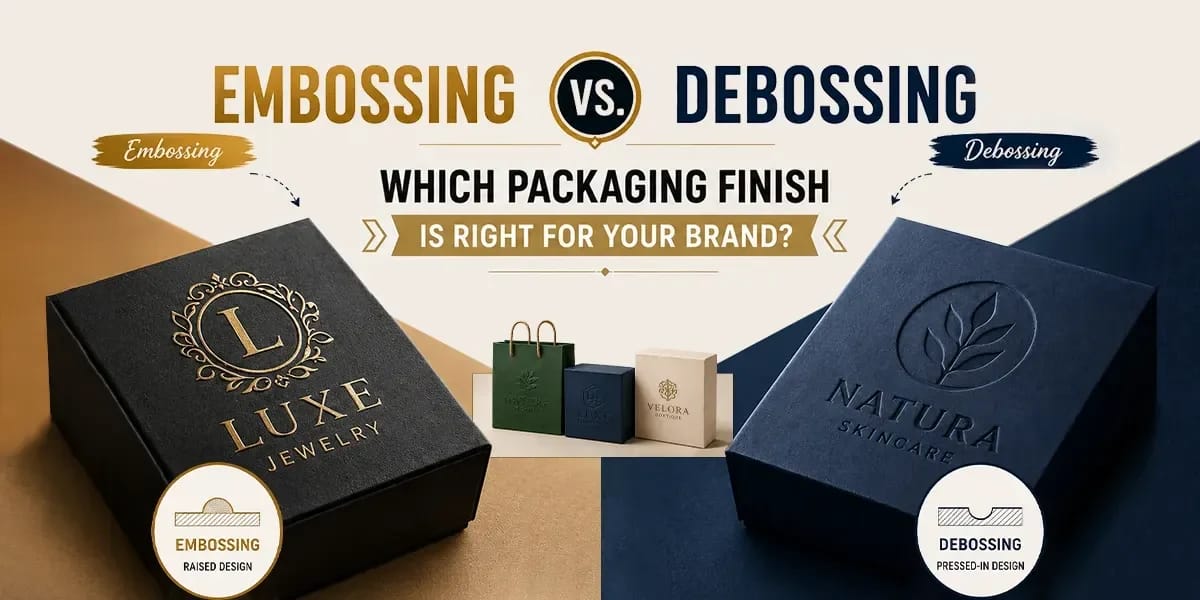
Among the many finishing techniques available, embossing and debossing are two of the most preferred choices. Both are used to highlight logos, brand names, patterns, and other important design elements, but each creates a different visual effect.
While one adds a raised appearance, the other creates a recessed impression.
In this blog, we will explain the difference between embossing and debossing, their benefits, common applications, and how to choose the right finish for your brand.
Let’s get into it!
Key Takeaways!
- Embossing lifts logos, product names, and artwork from the box surface, helping these details get noticed more easily.
- Debossing presses the chosen design into the material, making it a suitable option for brands that prefer a quieter presentation.
- Embossing is often used for luxury products, cosmetics, perfumes, chocolates, and gift boxes.
- Debossing works for initials, fine-line artwork, clean typography, geometric patterns, and kraft packaging.
- Both techniques can be combined with foil stamping, Spot UV, matte lamination, or soft-touch lamination.
- The best finish depends on the product, graphic details, packaging material, and the level of attention you want your branding to receive.
What Is Embossing? A Detailed Explanation
Embossing is a packaging finish that gives selected design elements extra emphasis by pressing them above the surface of the box. Instead of relying only on ink or color, this technique makes logos, brand names, patterns, or artwork more noticeable the moment someone picks up the package. It is a popular choice for brands that want important details to catch attention without overcrowding the design.
How Is Embossing Created? What You Need to Know
The process begins with a custom metal die made according to your artwork. During production, the packaging material is placed between matching dies and pressed under controlled pressure. This shapes the selected areas while keeping the rest of the packaging unchanged.
Depending on the design, embossing can be used on its own or combined with finishes such as foil stamping, Spot UV, or soft-touch lamination for a more premium presentation.
It is commonly applied to:
- Company logos
- Product names
- Decorative artwork
- Graphic motifs
- Border accents
- Custom illustrations
- Brand identity elements
Because of its clean and noticeable appearance, embossing is widely used on luxury retail packaging, cosmetic packaging, custom gift boxes, perfume boxes, custom printed jewelry boxes, and many other premium packaging styles.
Debossing on Packaging Boxes: A Quick Overview
Some brands prefer a finish that reveals itself when customers take a closer look. By pressing selected artwork beneath the surface of the packaging, it creates a subtle impression that gives the box a simple yet refined appearance. It is often chosen by brands that value clean branding and timeless packaging over bold decorative effects.
How Is Debossing Applied to Packaging Boxes?
Creating this finish begins with a custom metal die made from the artwork. The die applies controlled pressure to the packaging material, leaving a permanent impression without using additional inks or special coatings.
Since the effect is created directly within the material itself, debossing remains part of the packaging throughout its use. It can also be combined with finishes like foil stamping or specialty papers when brands want a more distinctive result without relying on detailed graphics.
Debossing works particularly well with:
- Minimal branding
- Fine line artwork
- Large initials
- Clean typography
- Simple geometric designs
- Premium paper stocks
- Kraft packaging
Embossing vs. Debossing: A Quick Side-by-Side Comparison
Although embossing and debossing are often mentioned together, they create completely different results. The right choice depends on your branding style, packaging material, and the impression you want your product to leave.
The table below highlights the key differences between the two finishing techniques.
Features | Embossing | Debossing |
Effect | Design is pressed outward | Design is pressed inward |
Best for | Bold branding | Minimal branding |
Appearance | More noticeable | More subtle |
Common use | Logos, artwork, product names | Typography, patterns, elegant branding |
Suitable for | Luxury, retail, and promotional packaging | Fashion, stationery, and premium packaging |
Choosing the Best Finish for Your Custom Packaging Boxes: Key Considerations
There is no universal answer when it comes to choosing between embossing and debossing. Both finishing techniques can improve the appearance of custom packaging, but they serve different branding goals.
Considering the following elements before production can help you choose a finish that complements both your packaging and your brand.
Choose the Details You Want to Highlight
If your logo or product name is meant to be one of the first things customers notice, embossing is often the better option. It gives key branding elements a clearer look and works well for products displayed on retail shelves or in promotional settings where first impressions matter.
Balance Your Branding Details without Overemphasizing Them
Debossing is a great choice for brands that appreciate a simpler packaging style. Rather than drawing immediate attention, it creates a more reserved finish that blends naturally with the overall design. This approach is commonly seen on premium stationery, fashion packaging, and high end gift boxes.
Consider the Type of Product You Are Packing
The product itself can also influence your decision. Cosmetics, perfumes, chocolates, candles, and luxury gifts often benefit from embossing because it helps branding become more noticeable.
On the other hand, debossing is frequently selected for apparel, leather goods, notebooks, and other products where a cleaner presentation suits the brand image.
Think About the Material You Have Chosen
Both techniques can be applied to paperboard, rigid, chipboard, and kraft paper, but some materials produce better results depending on the design. Thicker packaging stocks can create sharper impressions, while textured papers can give debossed designs a more distinctive appearance.
Note: Discussing your artwork and material together before production helps achieve better results.
So, Which One Should You Choose?
If your priority is making important branding elements easier to recognize, embossing is usually the better choice. If you want packaging that communicates through simplicity and fine detailing, debossing is worth considering.
Evaluating your branding goals, product category, packaging material, and overall design will help you choose the finish that best represents your brand.
Using Embossing and Debossing Together: Is It the Right Choice?
Why Do Some Brands Use Both Finishes?
Many brands combine embossing and debossing to give different parts of the packaging their own special look. Instead of relying on a single finishing technique, they use one to emphasize key branding and the other to add supporting details. This approach is especially popular for limited edition collections, premium product lines, and custom presentation boxes.
If you want to explore a smarter approach to creating your packaging, “How to Use AI for Packaging Design to Create Smarter and Faster Product Packaging” provides useful tips for developing an appealing and effective design.
Effective Ways to Combine Both Finishes
A successful combination starts with deciding which details deserve the most attention. Some popular approaches include:
- Use embossing for the company logo while debossing for decorative borders.
- Highlighting the product name with embossing and adding debossed background patterns.
- Embossing a seal, badge, or emblem while debossing surrounding artwork.
- Pairing both finishes with foil stamping to create a layered branding effect.
Is This the Right Choice for Every Packaging Project?
Not necessarily. Using embossing and debossing together is most effective when the packaging includes multiple branding elements that need different levels of emphasis. It is often a suitable choice for luxury products, premium gift boxes, cosmetics, perfumes, and limited-edition collections.
For simpler packaging designs, however, using just one finishing technique is often enough to achieve the desired result without adding unnecessary production costs.
How Different Packaging Materials Affect Embossing and Debossing
Choosing between embossing and debossing is only part of the process. The packaging material also influences how noticeable the finish becomes once production is complete. Before selecting a finishing technique, it is worth understanding how different materials act during manufacturing.
Paperboard (SBS)
Paperboard is one of the suitable materials to work with because of its smooth surface. It allows both embossing and debossing to produce consistent impressions, making it a preferred option for packaging that requires clean branding and precise finishing.
Kraft Paper
The natural fibers of kraft paper create a different result than coated paperboard. Rather than producing sharp impressions, the finish appears softer and more natural. For this reason, custom kraft boxes are often selected by brands looking for environmentally conscious presentation.
Rigid Boxes
Rigid packaging can withstand greater pressure during production, allowing embossing and debossing to appear more prominent. This makes it a popular material for premium custom product boxes where the finish itself becomes part of the overall presentation.
Corrugated Board
Corrugated packaging contains a fluted inner layer; it responds differently from solid paperboard. Large branding elements and simple shapes generally perform better than smaller or closely spaced designs, especially on shipping and custom mailer boxes.
Specialty Papers
Papers with linen, laid, or other textured finishes add another dimension to packaging. The texture interacts with the embossing or debossing, creating a finish that feels more distinctive than the same design produced on a smooth surface.
Choosing the Right Combination
Rather than selecting a finish first, many packaging manufacturers recommend choosing the material and finishing technique together. This helps achieve a result that complements the product, the packaging, and the brand without unnecessary trial and error.
Final Thoughts - Before You Make Your Choice!
Embossing and debossing have become two of the most widely used finishing techniques in custom packaging because each offers a different way to enhance an appearance. The better option depends on what you want to achieve, whether it is giving more importance to selected branding elements, creating a cleaner presentation, or combining both techniques for a balanced result.
Taking time to evaluate your packaging material, product type, and overall design before production can make the decision much more straightforward.
If you are planning a custom packaging project and need guidance on selecting the right finishing technique, the team at BoxLark can help you and recommend a solution based on your packaging requirements.
For expert assistance, you can reach us at sales@boxlark.com!