


10 Must-Ask Questions Before Buying Custom Packaging
Discover how premium packaging transforms your brand's perception and drives customer loyalty in today's competitive market.
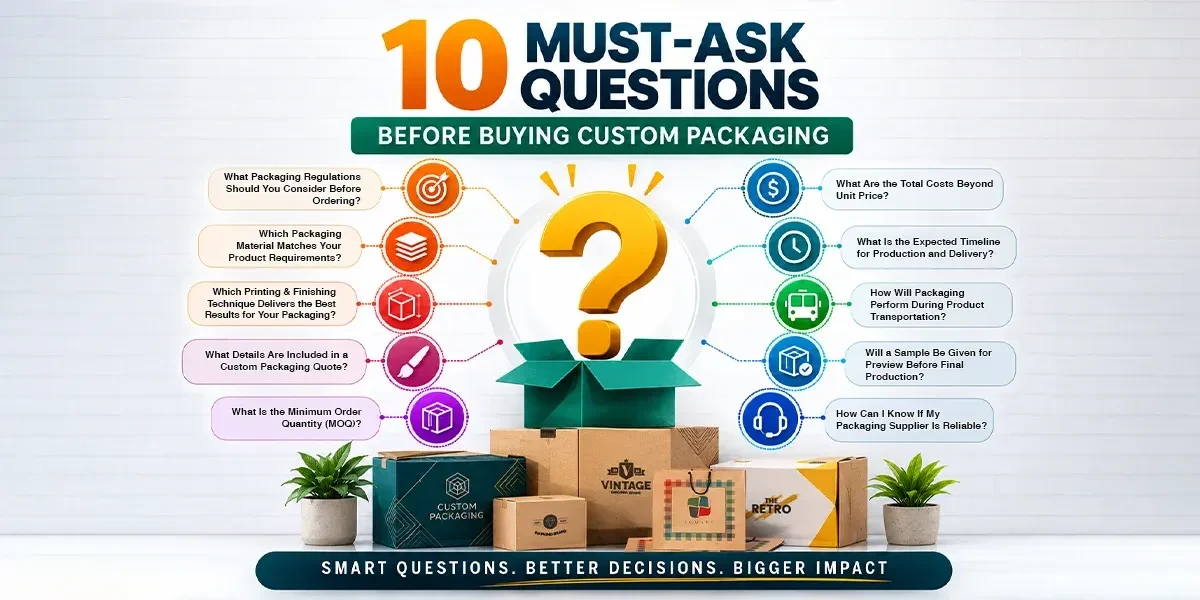
- Key Takeaways
- Significance of Asking Questions Before Buying Custom Packaging
- 1. Which Packaging Material Matches Your Product Requirements?
- 2. Which Printing & Finishing Technique Delivers the Best Results for Your Packaging?
- 3. What Packaging Regulations Should You Consider Before Ordering?
- 4. What Details Are Included in a Custom Packaging Quote?
- 5. What Is the Minimum Order Quantity (MOQ)?
- 6. Will a Sample Be Given for Preview Before Final Production?
- 7. How Will Packaging Perform During Product Transportation?
- 8. What Is the Expected Timeline for Production and Delivery?
- 9. What Are the Total Costs Beyond Unit Price?
- 10. How Can I Know If My Packaging Supplier Is Reliable?
- Closing Insights!
If you are buying custom packaging for the first time, you may wonder what questions you should ask your packaging supplier before placing an order. Should you ask about materials, packaging style, printing, pricing, minimum order quantity, or production time? The answer is yes, because each detail can affect the final packaging and your overall buying experience.
“The Right Questions Can Prevent the Wrong Packaging Decision!”
Getting clear answers helps you compare options, understand what is included in your order, and avoid unexpected costs or delays.
In this article, we’ll discuss 10 essential questions to ask before buying custom packaging and explain why each one matters.
Without further ado, let’s begin by understanding the importance of asking these questions!
Key Takeaways
- Ask about the available materials, packaging styles, and customization options before placing your order.
- Confirm the total pricing, minimum order quantity, and any additional charges that may apply.
- Discuss printing, finishing, and quality requirements to make sure the final packaging meets your expectations.
- Clarify production time, delivery details, and order specifications before approving the order.
- Compare packaging suppliers based on their quality, experience, capabilities, and customer service.
Significance of Asking Questions Before Buying Custom Packaging
The majority of customers begin the purchasing process by focusing mainly on price or appearance. These elements are essential; however, they might not consistently reflect the overall value or quality of the packaging material
If a brand fails to comply with your requirements, there may be occurrences of incorrect sizing, printing errors, delivery delays, or additional charges.
For instance, an online store can purchase custom mailer boxes without checking the dimensions of their products
Result?
The result will be in the form of product damage and extra cost of replacements.
Note: Proper inquiry before placing an order is what will help companies avoid such problems.
Let’s start discussing the questions one by one.
1. Which Packaging Material Matches Your Product Requirements?
The first question buyers should ask before ordering custom packaging is about material selection. The material you choose affects packaging strength, product protection, appearance, shipping costs, and overall performance.
Selecting the wrong material can result in damaged products, unnecessary expenses, or packaging that does not match your product requirements. Different products require different levels of protection and presentation.
Let's take an example:
A beauty brand shipping glass skincare bottles may choose rigid boxes with inserts to prevent movement during transit, while a clothing brand may prefer lightweight mailer boxes or folding cartons.
Similarly, e-commerce products require durable packaging that can withstand handling, whereas retail products may benefit from visually appealing custom printed boxes or durable custom printed bags that enhance shelf presentation.
The table below compares common packaging materials by strength, cost level, and their most suitable applications, helping you identify the right option for your product.
Materials | Strength | Cost Level | Best For |
Kraft Paper | Medium | Low | Food packaging with food-safe coating, retail bags, eco-friendly packaging |
Corrugated | High to Very High | Medium | Shipping boxes and ecommerce packaging |
Paperboard | Medium | Low to Medium | Folding cartons, retail boxes, product packaging |
Rigid Stock | High | High | Luxury boxes and premium packaging |
BoPET (Polyester Film) | High | Medium to High | Flexible pouches and products requiring barrier protection |
What Buyers Should Discuss with Suppliers
Before finalizing materials, ask your custom packaging supplier about:
- Product weight and dimensions
- Required protection level
- Shipping conditions
- Available material options
- Eco-friendly packaging materials
Skilled packaging manufacturers typically analyze the product initially rather than suggesting the same material for each order.
Addressing these details early enables companies to select packaging that offers:
Ideal equilibrium of quality, cost, and performance.
2. Which Printing & Finishing Technique Delivers the Best Results for Your Packaging?
The printing method you choose can directly affect the appearance, quality, and cost of your custom printed packaging. Before placing an order, it is important to understand which printing system matches your packaging requirements, order quantity, and design complexity.
Choosing the right method helps ensure better print results while avoiding unnecessary production costs.
Common Printing Methods Used for Custom Packaging
Printing Methods | Suitable For |
Digital Printing | Small batches, prototypes, and detailed designs |
Offset Printing | Large production runs and premium packaging |
Flexographic Printing | High-volume shipping boxes and corrugated packaging |
Screen Printing | Specialty designs and limited production runs |
Laser Printing | Short runs and precise packaging designs |
Each printing method offers different advantages depending on the project requirements.
For example, a small business launching a limited product line may benefit from digital printing because it allows shorter runs without extensive setup. In contrast, brands producing large quantities may prefer offset printing for detailed graphics or flexographic printing for high-volume shipping packaging.
Understanding CMYK and PMS Color Systems - Must Consider
Along with selecting a printing method, buyers should also consider the color system required for their packaging. CMYK and Pantone (PMS) are two commonly used color systems, and each offers different benefits depending on design needs, color accuracy, and budget
Color System | How It Works | Best For |
CMYK | Uses cyan, magenta, yellow, and key (black) to create a wide range of colors | Photographs, detailed graphics, and cost-effective packaging |
Pantone (PMS) | Uses pre-mixed inks to achieve precise color matching | Brands requiring consistent colors across packaging orders |
Packaging Finishes to Consider
Finishing options add visual appeal and improve the overall feel of packaging.
Common options include:
- Foil stamping for metallic effects
- Embossing and debossing for textured designs
- Spot UV coating for highlighted areas
- Matte or gloss lamination for surface protection
Discussing color requirements and finishing options with a custom packaging manufacturer before production helps businesses achieve packaging that matches their design expectations while staying within budget.
3. What Packaging Regulations Should You Consider Before Ordering?
Before placing a custom packaging order, buyers should confirm whether the packaging meets the regulations required for their product category and target market. Compliance requirements can vary depending on the industry, materials used, and where the products will be sold.
Failing to meet these requirements can lead to product recalls, shipping issues, or market restrictions.
Common Packaging Compliance Areas to Consider
Different industries may require attention to:
- Food Safety Requirements: Food packaging must meet requirements for approved food contact materials, safety testing, and traceability.
- Sustainability Requirements: Many markets now focus on recyclability, sustainable material sourcing, and waste reduction.
- Labeling Standards: Some products require specific information or markings on their packaging.
Certifications Buyers Should Ask About
Certifications / Compliance | Purpose |
FSC | Responsible paper and forestry sourcing |
ISO 9001 | Quality management systems |
BRCGS | Packaging safety standards |
FDA Compliance | Compliance with applicable U.S. FDA requirements for food-contact materials |
Certification needs depend on the product type and market regulations. Working with a knowledgeable custom packaging company helps businesses identify required standards before production begins and avoid compliance-related issues later.
4. What Details Are Included in a Custom Packaging Quote?
Before placing an order, buyers should understand what details are included in a custom packaging quote. The final price depends on several factors beyond the packaging design.
Factors such as material selection, printing requirements, finishes, and additional services can influence the overall cost.
A detailed quote from your custom packaging supplier helps you identify included services and charges that may apply separately.
Cost Component | Usually Included? |
Material | ✔ |
Printing | ✔ |
Finishes | ✔ |
Shipping | Sometimes |
Die Creation | Sometimes |
Storage | Optional |
Some services, such as custom die creation, rush production, or storage, may increase the budget if they are not discussed beforehand.
Reviewing every cost factor before approval helps businesses compare suppliers accurately, plan their budget, and avoid unexpected expenses during production.
5. What Is the Minimum Order Quantity (MOQ)?
Minimum Order Quantity (MOQ) is the smallest number of packaging units a supplier mandates you purchase in a single production run. Discussing MOQ is important as it influences your financial plan, stock levels, and storage needs, particularly for startups and small enterprises seeking custom product packaging.
Big companies prefer to go for wholesale custom packages because large quantities can lower the price per unit. Nevertheless, small firms do not require bulk packages when introducing their products to the market.
For instance, a new bakery providing seasonal items might not require thousands of custom bakery boxes initially. Requesting a smaller batch enables the company to control storage, evaluate packaging options, and adjust the order quantity based on sales before placing larger orders.
Before finalizing the deal with a supplier, ask about:
- Minimum order requirements
- Small batch options
- Prototype availability
- Price differences between order quantities
Selecting the appropriate MOQ allows companies to prevent surplus stock while ensuring affordable packaging options.
6. Will a Sample Be Given for Preview Before Final Production?
An important consideration to take into account before making a large-scale order is to see whether the company provides samples before mass production. While the design may seem perfect on the computer, the package may look different once it is printed and assembled. This enables buyers to detect any issues that may arise regarding the material, measurements, printing, and design.
Digital Samples vs Physical Samples
Most suppliers provide two types of samples:
Sample Type | Advantages | Limitations |
Digital Sample (2D/3D Mockup) | Quick, affordable, and useful for design approval | Cannot show actual material quality, texture, or durability |
Physical Sample | Shows real materials, printing, structure, and finishes | Requires additional time and cost |
A physical sample allows buyers to inspect:
- Packaging dimensions and product fit
- Color accuracy and printing quality
- Folding and structural strength
- Insert placement
- Finishing details
- Material durability
Why Sample Approval Matters
Skipping sample testing may lead to costly corrections after production. For instance, a retail company that orders custom retail boxes might approve the digital design but later realize that the box dimensions are unsuitable for the product or the finish does not align with the expected look.
Examining the sample before production will help companies make necessary changes and minimize risks associated with the production process.
7. How Will Packaging Perform During Product Transportation?
A package should not only look appealing but also protect the product throughout the supply chain. Before buying custom packaging, businesses should ask suppliers whether the packaging can withstand storage, handling, and transportation.
Understanding common shipping risks and the tests used to evaluate packaging strength can help buyers choose solutions that provide better protection.
Shipping Challenge | Testing Method | Purpose |
Compression from stacking during storage or delivery | Compression Testing | Checks resistance against stacking pressure |
Moisture exposure from humidity and weather conditions | Moisture Resistance Testing | Evaluates moisture resistance and material performance |
Continuous movement during transportation | Vibration Testing | Measures packaging stability during transit |
Drops or rough handling during loading and delivery | Drop Testing | Evaluates protection against impact |
Pressure on packaging materials | Burst Testing | Tests material strength and durability |
For example, an e-commerce brand shipping fragile products may need stronger custom shipping boxes instead of a lightweight structure. So, choose wisely!
Pro Tip: A reliable custom packaging manufacturer should be able to explain how the packaging is tested and optimized for real shipping conditions.
8. What Is the Expected Timeline for Production and Delivery?
Production and delivery timelines can directly affect inventory planning, product launches, and customer demand. Before buying custom packaging, businesses should ask suppliers about estimated turnaround times to avoid delays and ensure packaging is available when needed.
Typical Custom Packaging Timeline
Stage | Typical Time |
Design Approval | 2 to 5 days |
Sample Production | 3 to 7 days |
Manufacturing | 10 to 20 days |
Shipping | Depends on destination |
Real timelines may differ based on packaging type, order size, material availability, and production needs.
Factors That Can Affect Delivery Time
Common causes of delays include:
- Artwork changes or approval delays
- Material shortages
- Complex packaging structures
- High seasonal demand
- Shipping delays
For example, a candy brand preparing for holiday sales may need to order custom Christmas boxes a few months in advance to avoid stock shortages during peak demand.
What Should You Ask?
When collaborating with a custom packaging manufacturer, inquire about their production capacity, projected completion dates, and potential delays. Advanced planning enables companies to prevent last-minute expenses and ensure a consistent supply of packaging.
9. What Are the Total Costs Beyond Unit Price?
Many buyers compare custom packaging suppliers by looking only at the price per unit. However, the lowest quote does not always represent the lowest overall cost.
Additional expenses related to production, shipping, and customization can significantly affect the final budget.
Hidden Costs Buyers Should Consider
Before choosing a supplier, ask whether the quote includes:
- Printing plate or setup charges
- Sampling fees
- Shipping expenses
- Warehousing costs
- Design revisions
- Quality inspection fees
For example, a brand may choose a supplier offering a lower unit price but later discover extra charges for multiple artwork revisions, urgent production, or shipping. These unexpected expenses can increase the final packaging cost significantly.
Looking beyond the quoted price helps businesses understand the true investment required for custom packaging. Considering long-term expenses, product protection, and supplier reliability allows buyers to make more cost-effective decisions.
10. How Can I Know If My Packaging Supplier Is Reliable?
Choosing a reliable custom packaging supplier is as important as selecting the right material or design. While pricing matters, a supplier’s experience, production quality, and ability to meet deadlines determine the success of your packaging order.
Before placing an order, evaluate a supplier based on:
- Industry Experience: Experienced suppliers understand materials, production challenges, and product requirements.
- Production Capabilities: Ensure they can handle your order volume, packaging style, and customization needs.
- Quality Control: Ask about inspection processes and consistency checks.
- Portfolio: Review past projects to assess printing quality and structural expertise.
- Communication: Reliable suppliers provide clear updates about pricing, timelines, and revisions.
For example, a brand choosing a supplier only because of a low quote may later face printing inconsistencies or delivery delays.
That's why reviewing supplier experience and processes beforehand helps reduce these risks.
A trustworthy packaging supplier prioritizes transparency, quality, and long-term support instead of focusing only on the lowest price.
Closing Insights!
Buying custom packaging is not like ordering a pizza where you simply choose a size, pick a topping, and wait for delivery. Every packaging order has its own recipe. Instead of simply relying on what a packaging company recommends, take an active role in the decision-making process. Asking questions about materials, production methods, costs, timelines, and quality standards allows you to understand what works best for your business. It also helps you avoid unexpected expenses, costly mistakes, and decisions that may affect your budget in the future. Maintaining clear communication and transparency with your packaging supplier helps build trust and ensures the final packaging meets your expectations.
The better you understand your packaging needs, the easier it becomes to choose a supplier that can deliver them. You can start with BoxLark. With years of experience in the packaging industry, they have helped businesses create packaging that matches their brand vision. Brands choose our services due to our dedication to quality, dependable support, and long-term partnerships.