


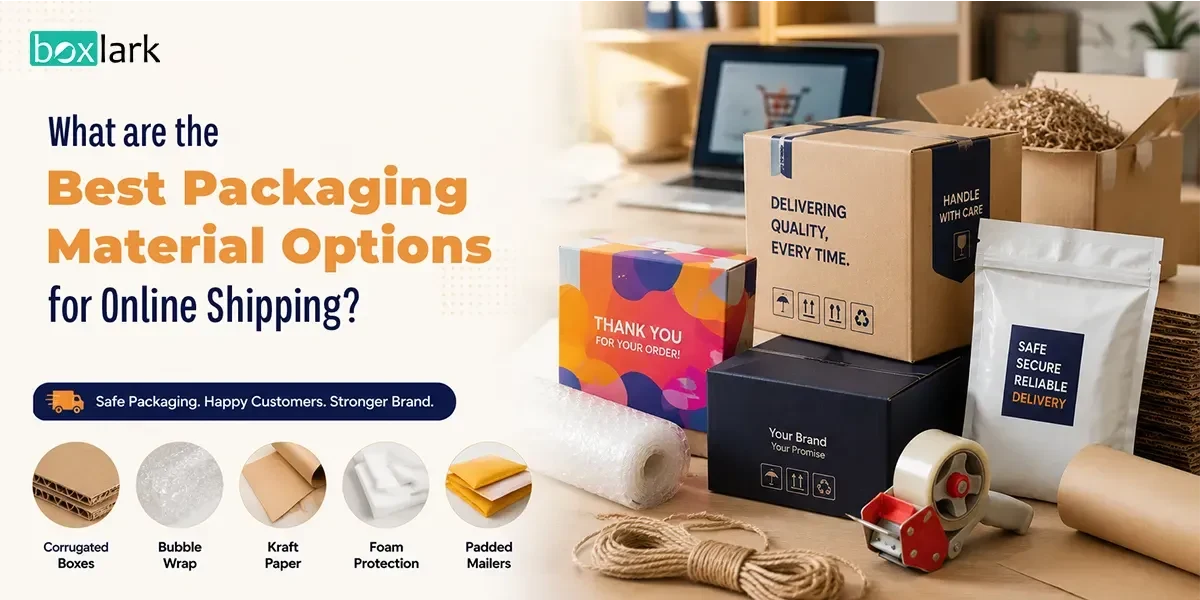
What Are the Best Packaging Material Options for Online Shipping?
Discover how premium packaging transforms your brand's perception and drives customer loyalty in today's competitive market.
- Importance of Choosing the Correct and Best Packaging Material for Safe Delivery
- What is the Strongest Material for Shipping? Choosing Outer Packaging Solutions
- Inner Packaging Materials: Cushioning and Void Fill Strategies for Product Security
- Packaging Performance: How to Test and Validate Your Packaging Materials
- The Most Common Packaging Pitfalls - How Every Online Business Can Prevent Them
- Comparative Analysis of Packaging Materials for Various Products
- Final Thoughts: Where to Order Reliable Shipping Supplies
Long before a package reaches a customer’s doorstep, it passes through warehouses, delivery trucks, and many handling stages. At every stage, even a small mistake in packaging can turn a perfectly good product into a costly return. That’s why choosing the best packaging material is not just a logistical necessity; it is a financial decision and an essential part of customer experience. Want to know more? Strong packaging protects products, reduces damage-related losses, and directly influences how customers perceive a brand.
This guide breaks down the best packaging materials for online shipping, detailing exactly when to use them and what to avoid.
Importance of Choosing the Correct and Best Packaging Material for Safe Delivery
Selecting a box or a mailer is not a guessing game. The materials you use dictate your shipping costs, your return rates, and how customers view your brand. Before looking at specific materials, you need to evaluate your products against four critical variables.
Product Protection and Fragility
Can your product survive a three-foot drop onto a concrete floor? If the answer is no, your packaging strategy must prioritize total immobilization. Heavy items require structural rigidity so the bottom of the container does not burst open. Fragile items might not weigh much, but they demand a rigid outer shell and form-fitting internal cushioning to survive the impact of automated sorting belts and delivery trucks.
Shipping Cost Efficiency and Dimensions
Do you know how carriers actually calculate your shipping bills? They do not just put your box on a scale. They measure it. The shipping industry calls this Dimensional Weight, or DIM weight.
Here is the standard formula used by major carriers like UPS and FedEx:
- Multiply the package length by width by height in inches
- Divide that number by 139 (the standard domestic DIM divisor)
- Compare the resulting number to the actual scale weight
- You pay for whichever number is higher
If you ship a small item in an oversized box, you pay for the empty space inside. Using the right box size helps lower fulfillment costs.
You can learn more about it from this blog: Custom Packaging Dimensions: Length, Width & Height Explained
Customer Experience
Have you ever received a luxury item in a crushed or damp box? A product arriving in a cheap poly mailer, or an overly bulky box filled with messy styrofoam peanuts, creates a negative impression. Intentional packaging materials, like a well-fitting mailer box, molded inserts, or branded custom tissue papers, increase the perceived value of the product inside.
Sustainability Considerations and Environmental Impact
Conscious consumers pay attention to packaging waste. Did you know that packaging accounts for nearly 30% of all municipal solid waste generated in the U.S. annually? Materials that end up in landfills or that are too confusing for customers to recycle reflect poorly on a brand. The most sustainable choice is always the lightest and smallest packaging that guarantees safe delivery. This naturally reduces carbon emissions.
What is the Strongest Material for Shipping? Choosing Outer Packaging Solutions
Now that we understand the logistical rules for shipping, we can look at the specific materials used to create your shipment's outer shell.
Corrugated Cardboard: The Strongest Shipping Material for Most Applications
Corrugated board is widely regarded as one of the strongest and most reliable shipping materials for most applications due to its fluted inner structure sandwiched between two linerboards. This design offers an excellent strength-to-weight ratio, making it the default choice for the majority of e-commerce shipments.
Single-Wall vs. Double-Wall vs. Triple-Wall
- Single-wall: Features one layer of fluting. Used for standard items like clothing, books, and plastics.
- Double-wall: Features two layers of fluting. This is used for items like small appliances, automotive parts, or dense goods.
- Triple-wall: Features three layers of fluting. Used for industrial parts, bulk shipments, or extremely heavy items. Most direct-to-consumer businesses never need triple-wall.
Advantages
- Highly customizable and easy to stack on pallets.
- Universally accepted in curbside recycling programs.
- Available in hundreds of standard sizes for rapid fulfillment, or custom-printed for branding.
Best Applications
Mixed product orders, heavy items, fragile goods requiring internal cushioning, and shipments navigating long transit networks.
Eco-Friendly Kraft Paper Packaging for Shipping
Kraft paper is a sustainable packaging material, making it an environmentally friendly choice for modern e-commerce businesses. Apart from that, it is also recyclable and biodegradable. It is lightweight yet strong, making it ideal for wrapping and void filling.
Best Uses
Kraft paper is used for wrapping items and filling empty spaces in cartons. It also protects items from scratches. It is ideal for e-commerce packaging, gift wrapping, and retail packaging.
Poly Mailers: Lightweight and Cost-Effective
Poly mailers are flexible, waterproof plastic bags designed for non-fragile items. They conform tightly to the shape of the product, which reduces DIM weight surcharges.
- Water Resistance
Traditional poly mailers are made of Low-Density Polyethylene (LDPE). This plastic acts as an excellent barrier against rain, snow, and humidity. If you want a greener option, compostable alternatives made from PBAT and PLA offer similar good resistance to water but break down in industrial composting facilities rather than sitting in a landfill for decades.
- Cost Savings
Poly mailers weigh mere ounces and take up almost no storage space in a warehouse. Custom poly mailers are the cheapest way to ship soft goods. They drastically lower postage costs compared to boxes of the same volume.
- Ideal Products
T-shirts, leggings, bedding, stuffed animals, and any soft, unbreakable goods.
Rigid Packaging Material for Luxury and Fragile Products
Rigid boxes are made of tightly compressed, non-corrugated paperboard that is typically 2mm to 4mm thick. They do not fold flat for storage. They arrive at your warehouse pre-assembled.
- Premium Appearance
Rigid packaging boxes have a high-end feel. They are often wrapped in printed paper, textured materials, or foil-stamped. They do not look like shipping containers. They look like luxury retail displays.
- Superior Protection
The walls do not bend; that’s why rigid boxes prevent products from shifting. When cut to the product's exact dimensions, they offer excellent structural protection against crushing forces.
- Common Applications
High-end electronics like smartphones and headphones, luxury cosmetics, designer jewelry, and premium fashion items.
Inner Packaging Materials: Cushioning and Void Fill Strategies for Product Security
A box alone rarely guarantees a safe arrival. Any space inside a carton becomes a hazard during transit. That space allows the product to shift and sustain damage. Opting for the right internal cushioning is about stopping this movement without adding unnecessary weight to your shipment.
Here is a comparison table for ease:
Material | Protection Level | Cost Efficiency | Eco-Friendliness | Best Use Case |
Kraft Paper | Medium-High | Medium | High (Curbside Recyclable) | General void fill, medium-weight items |
Bubble Wrap | High | Medium | Low (Difficult to recycle) | Wrapping individual fragile items |
Air Pillows | Low-Medium | Low to Medium | Low (Single-use plastic) | Filling large empty spaces around sturdy items |
Molded Pulp | Very High | Medium (can be low in bulk production) | Very High (Compostable) | High-value, perfectly fitted products |
Foam Inserts | Very High | Medium | Very Low (Non-biodegradable) | Heavy electronics (declining in popularity) |
Packaging Performance: How to Test and Validate Your Packaging Materials
Before you order a thousand units of a new box or mailer, you must test your packaging setup. Do not rely on a visual inspection alone. You can perform some tests, such as:
- The Shake Test: Pack your product exactly as you would for a customer. Seal the box and shake it vigorously. If you hear or feel any movement, add more void fill.
- The Drop Test: Pack the item and drop it from waist height onto a hard floor. Drop it on every corner, every edge, and flat on its face. Open the box and inspect the product for damage.
- The Weight Test: Place the sealed box on a stable surface and apply moderate pressure from above to replicate the load of stacked packages during transit. If the walls buckle, you need a thicker flute or a double-wall box.
The Most Common Packaging Pitfalls - How Every Online Business Can Prevent Them
Even with the right materials on hand, poor execution can lead to damaged goods and wasted money. Avoid these frequent fulfillment errors.
Using Oversized Boxes
This is the most costly mistake in e-commerce. Putting a small item in a large box guarantees you will overpay for DIM weight shipping. It also requires excessive void fill, which increases both material costs and packing time for your warehouse staff. Always aim for two inches or less of space on all sides of your product.
Insufficient Cushioning
If you can hear the item shifting when you shake the closed box, the cushioning is inadequate. The product must be completely immobilized to prevent damage from impact or vibration during transit.
Overpacking
While under-packing is dangerous, overpacking is a massive waste of resources. Using three layers of bubble wrap for a non-fragile plastic item increases your material costs and frustrates customers who then have to break down a huge box just to throw it away.
Ignoring Moisture Protection
Standard custom corrugated boxes absorb water easily. If you are shipping items during winter months or to rainy climates, failing to use poly mailers, water-activated tape, or interior poly bags can result in water-damaged goods. Water-resistant coatings are especially useful because they adhere directly to the cardboard, helping protect packages from humidity, spills, and light rain.
Choosing the Wrong Material
Shipping a heavy metal part in a thin mailer box or shipping a delicate silk blouse in a rigid box with no interior wrapping are examples of mismatched materials. Always match the durability of the packaging to the physical needs of the product.
Comparative Analysis of Packaging Materials for Various Products
To simplify the selection process, use the following reference table to match your product type with the most appropriate outer and inner materials.
Product Category | Outer Packaging | Inner Protection | Primary Benefit |
Apparel & Soft Goods | Poly Mailer (Gusseted if needed) | Tissue paper | Lowest possible shipping weight and cost |
Cosmetics & Skincare | E-flute Mailer Box | Molded pulp insert | Clean presentation, prevents glass breakage |
Consumer Electronics | Double-wall Corrugated | Custom foam or pulp insert | Maximum crush resistance and shock absorption |
Fragile Homeware | C-flute Corrugated Box | Bubble wrap + kraft paper void fill | Adaptable to irregular, highly breakable shapes |
Books & Media | Padded Mailer | Integrated paper bubble lining | Protects corners from bending, low DIM weight |
Luxury Fashion | Rigid Box | None required (snug fit) | Creates a premium, keepsake unboxing experience |
Final Thoughts: Where to Order Reliable Shipping Supplies
The best packaging material for online shipping depends entirely on what you are sending. Mastering your box sizes to control dimensional weight and choosing the right cushioning takes trial and error, but getting it right protects your profit margins and your brand reputation at the same time.
Transitioning from theory to practice requires a reliable supplier. For brands seeking an online packaging partner that listens closely to specific fulfillment requirements, BoxLark offers affordable solutions aimed at reducing transit loss and increasing customer satisfaction. Inquiries regarding custom shipping needs can be sent directly to sales@boxlark.com.