


What Are Smart Authentication Features in Custom Packaging and How Do They Prevent Counterfeit Products?
Discover how premium packaging transforms your brand's perception and drives customer loyalty in today's competitive market.
- Key Takeaways!
- How Authentication Features Strengthen Packaging Security: Understand Their Role
- Types of Authentication Features Used in Custom Packaging
- Physical vs. Digital Authentication: What’s the Difference?
- Which Industries Benefit From Authentication Packaging?
- Designing Custom Packaging With Authentication Features: Understand the Process
- What Can Go Wrong With Packaging Authentication? Know the Common Mistakes
- The Benefits of Adding Authentication to Custom Packaging
- Conclusion: Core Considerations for Strengthening Packaging Security
Products that do not have any authorization from the original company and look like the original product are termed counterfeit products. They can be difficult to distinguish from authentic products when the packaging is copied closely, creating problems for both brands and customers. Beyond lost sales, counterfeit goods can damage a brand’s reputation and make it harder for customers to trust what they are buying.
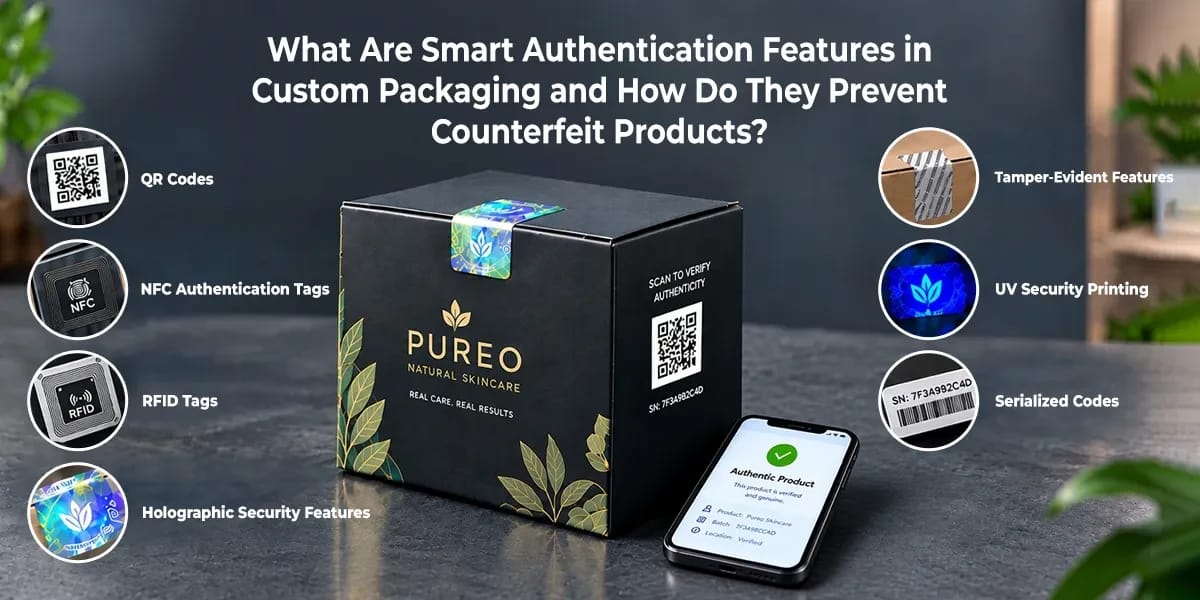
For brands facing this challenge, packaging can provide an important layer of protection. Rather than only depending on logos and details printed on the packages, there can be authentication features added to the packaging that make it difficult to counterfeit while also making it easy to identify the product. This includes the use of QR codes, NFC tags, RFID tags, holograms, UV marks, and serial numbers.
In this blog, we will explain what smart authentication features are, how they work, and how they help prevent counterfeit products. We will also look at the different authentication technologies used in custom packaging, the difference between physical and digital verification, and which options may be suitable for different industries.
Continue reading to find out.
Key Takeaways!
- Authentication features make packaging harder to counterfeit and help verify genuine products.
- QR codes, NFC, RFID, holograms, UV marks, and serialized codes offer different security options.
- Physical and digital methods can be combined for stronger product verification.
- Industries like pharmaceuticals, cosmetics, luxury goods, electronics, food, and automotive can benefit from authentication features.
- The right method depends on counterfeit risk, packaging format, verification needs, and cost.
- Common mistakes include reused codes, weak security features, difficult verification, and skipping pre-production testing.
- Authentication helps brands, customers, retailers, and distributors identify suspicious or counterfeit products.
How Authentication Features Strengthen Packaging Security: Understand Their Role
Advanced authentication features are security measures added to packaging to help distinguish genuine products from unauthorized copies. They give each package a security mark, a unique identifier, or a verification method that is more difficult to reproduce than ordinary branding.
These anti-counterfeit measures can help brands in several ways:
- Limit the ease of packaging replication: Specialized security elements make it more challenging for counterfeiters to recreate the specific details found on authentic packaging.
- Give products a unique identity: Individual codes or identifiers can be assigned to packages, making duplicate information easier to detect.
- Support product verification: Customers, retailers, and distributors can check whether a product is genuine before purchasing or accepting it.
- Identify duplicated codes: If the same unique identifier appears on multiple packages, it can signal a possible counterfeit.
- Detect package tampering: Certain security features can indicate whether the original packaging has been opened or altered.
By adding authentication and verification features to custom packaging, brands can create another barrier against counterfeit production. The level of protection depends on the technology selected, how it is implemented, and whether different security measures are combined.
Types of Authentication Features Used in Custom Packaging
Brands can choose from several authentication technologies depending on the product, packaging format, and level of security required. Some are designed for quick customer verification, while others are more useful for retailers, distributors, or internal product tracking.
QR Codes for Product Verification
A unique QR code can be printed on each package and connected to a brand-controlled verification page. When scanned with a smartphone, it can display product details, authenticity information, or a confirmation message. Using a different code for each package is important because a single code printed across thousands of boxes can be copied easily.
NFC Authentication Tags
NFC tags allow customers to verify a product by tapping a compatible smartphone against the package. The tag can contain or connect to product-specific information, making it useful for premium products and items where direct digital verification is preferred.
RFID Tags
RFID uses radio-frequency signals to identify tagged products. Unlike QR codes, RFID does not require the tag to be directly visible for reading. It can support product identification and supply chain monitoring while adding another layer to packaging security.
Holographic Security Features
Holograms create changing visual effects that are difficult to reproduce accurately with standard printing. Brands can use custom holographic elements, logos, or patterns as visible security marks on boxes, custom labels, and seals.
UV Security Printing
UV inks can be used to print hidden text, symbols, numbers, or brand marks that are not normally visible under regular light. These details become visible under ultraviolet light, allowing authorized personnel to perform an additional check.
Serialized Codes
With serialization, every package receives a different identification number or code. Brands can record these numbers in their systems and use them to verify individual products. If the same code appears on multiple packages, it can indicate unauthorized duplication.
Tamper-Evident Features
Tamper-evident seals, labels, closures, and tear strips are designed to show visible signs when packaging has been opened or interfered with. They do not authenticate the product by themselves, but they can work alongside other verification methods to provide additional protection.
Physical vs. Digital Authentication: What’s the Difference?
Authentication features generally fall into two broad categories: physical authentication and digital authentication. The main difference is how the product is checked.
Physical Authentication | Digital Authentication |
Verified by examining the packaging | Verified through a digital device or system |
Includes holograms, UV marks, and security inks | Includes QR codes, NFC, and digital IDs |
Can be checked without an internet connection in some cases | Often connects the package to digital product information |
Useful for quick visual or physical inspection | Can provide product-specific verification |
May be visible or hidden | Usually requires scanning, tapping, or entering information |
Can Both Methods Be Used Together?
Yes. Brands can combine physical and digital features when they need more than one way to check a product. For example, a package may carry a unique QR code along with a holographic mark. The QR code can provide digital verification, while the hologram gives the customer or retailer a physical feature to inspect.
Using multiple authentication methods can also make it harder for counterfeiters to reproduce the complete packaging, since they would need to copy both the physical security feature and the associated verification information.
Which Industries Benefit From Authentication Packaging?
Authentication packaging can be useful across industries where products are frequently copied, have high resale value, or require reliable product identification. Some of the main sectors include:
- Pharmaceuticals: Verification features can help distinguish genuine medicines and healthcare products from unauthorized copies.
- Cosmetics and skincare: Brands can use authentication features to help customers identify genuine products, especially for popular cosmetics and fragrances.
- Luxury goods: High-value products can benefit from unique codes, holograms, NFC tags, and other security elements.
- Electronics: Authentication can help distinguish genuine devices, accessories, and components from counterfeit products.
- Food and beverages: Authentication features help brands confirm product legitimacy and identify packaging that has been replicated without authorization.
- Automotive parts: Product identification features enable manufacturers, distributors, and buyers to distinguish genuine components from unauthorized copies.
The right authentication method depends on the product, counterfeit risk, and how the package needs to be verified.
Designing Custom Packaging With Authentication Features: Understand the Process
Choosing an authentication method becomes easier when brands assess their packaging and security requirements step by step.
Step 1: Assess the Counterfeit Risk
Determine how likely the product is to be copied and whether counterfeit versions could create financial, safety, or reputational problems.
Step 2: Identify Who Will Verify It
Decide whether verification will mainly be performed by customers, retailers, distributors, or internal teams. This helps determine how accessible the authentication feature needs to be.
Step 3: Check the Packaging Format
Consider the box, carton, label, pouch, or other packaging being used. Available space, material, printing process, and package construction can affect the suitable options.
Step 4: Select the Verification Method
Choose a physical feature, digital method, or combination based on the required level of security. For example, a brand may combine a visible security mark with product-specific digital verification.
Step 5: Consider Production and Cost
The chosen feature should fit the packaging budget and production process without adding unnecessary complexity.
Step 6: Plan How Verification Will Be Managed
For digital or serialized features, decide how product information and verification records will be maintained so that the system remains useful after the packaging reaches the market.
What Can Go Wrong With Packaging Authentication? Know the Common Mistakes
Even when authentication features are included, poor implementation can reduce their effectiveness. Brands should look for these common issues:
- Using the Same Code on Every Package: A single QR code or identification number can be copied and reused. Individual codes provide stronger product identification.
- Relying on Only One Security Feature: One method may not be enough for products with a high counterfeit risk. Combining physical and digital features can provide additional verification.
- Making Security Features Too Easy to Copy: Simple printed marks may be reproduced through ordinary printing. Security elements should be selected based on how difficult they are to replicate or verify.
- Ignoring the Customer Verification Process: Customers should know where to find the feature and how to check it. A complicated process can discourage verification.
- Skipping Testing Before Production: Codes, tags, and security marks should be tested on the actual packaging before full production to identify readability, placement, or printing issues.
The Benefits of Adding Authentication to Custom Packaging
Authentication features can add value beyond basic product identification. Their main benefit is giving brands and customers additional ways to distinguish genuine products from unauthorized copies.
For Brands
- Helps protect brand reputation from counterfeit goods
- Provides another method for identifying suspicious products
- Can support product identification across distribution channels
- Makes copied packaging more difficult to reproduce accurately
For Customers
- Provides a way to check product authenticity
- Helps them identify suspicious packaging before purchase or use
- Can provide access to product information through digital verification
For Retailers and Distributors
- Supports product checks during receiving and distribution
- Makes individual products easier to identify
- Can help flag questionable products before they reach customers
The exact benefits depend on the authentication method used and how the verification system is implemented. For products with greater counterfeit risks, combining different security features can provide broader protection.
Conclusion: Core Considerations for Strengthening Packaging Security
Counterfeit products continue to challenge brands, making packaging security essential. Authentication features make copying harder and help customers, retailers, and brands verify genuine products.
The best approach depends on the product, counterfeit risk, and distribution. Whether using serialized codes, QR, NFC, holograms, UV marks, or a mix, the feature should enable clear verification, not just decoration.
For brands adding authentication to custom packaging, BoxLark can help choose suitable formats and security options based on product needs. For more information or assistance, contact sales@boxlark.com.