


Custom Packaging Dimensions: Length, Width & Height Explained
Discover how premium packaging transforms your brand's perception and drives customer loyalty in today's competitive market.
- What Are Length, Width, and Height? What You Need to Know
- Why Does the Order of the Dimensions Matter?
- The Role of Dimensions in Custom Packaging Design
- Common Packaging Measurement Mistakes You Should Avoid
- Step-by-Step Guide to Measuring Length, Width, and Height Accurately
- Packaging Dimensions Beyond Boxes: Bags, Sheets, and Everything in Between
- Benefits of Accurate Dimensions in Custom Printed Packaging
- Consequences of Incorrect Measurements in Custom Printed Packaging
- Steps You Should Follow to Order Perfectly Sized Printed Packaging for Your Products
- Where You Can Order Perfectly-Sized Product Packaging?
- Final Insights!
Imagine you finally launch your product, and orders start coming. It's exciting, right? But soon after, customers started sending photos of damaged products. The culprit is not the product; it's the packaging that you used to pack your products. Have you ever thought about the reason behind it? It might be because of the packaging being too loose that your product slides around during handling and shipping, which results in scratched surfaces or crushed corners of the product. On the contrary, maybe the packaging is so tight that the fragile parts of the product can not handle the pressure and end up getting stuck or broken. Either way, the result is the same, with returns, refunds, bad reviews, and angry customers.
What is the right solution? How can you prevent this? Many more questions arise. Here's the secret.
You can avoid this mess with just one simple step, i.e., measuring length, width, and height accurately. These three measurements might seem small, but they decide how snugly your product fits, how safely it travels, how neatly you can organize your storage, and lastly, how you can make customers satisfied.
Are you ready to grasp some in-depth information about length, width, and height? Read on!
What Are Length, Width, and Height? What You Need to Know
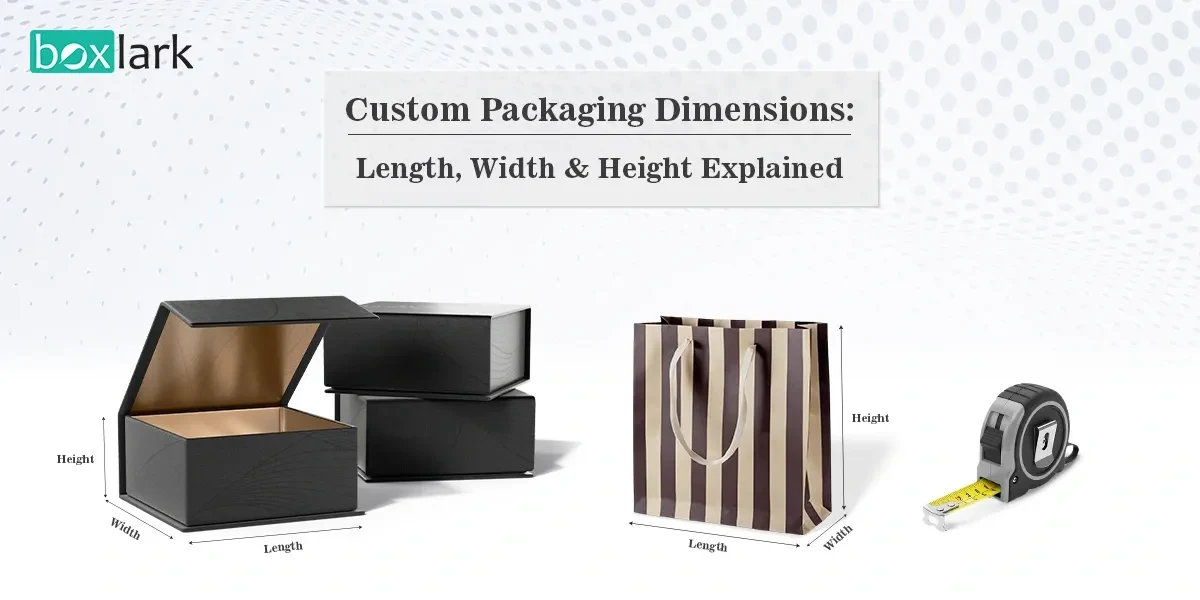
Have you ever wondered how a simple set of numbers can decide whether your packaging succeeds or fails? Length, width, and height define the shape and size of objects. In packaging, they describe the internal or external space of a box or a bag. Now, on the other hand, custom paper is measured in two dimensions (length and width) for flat sheets, but once folded or wrapped, it takes on a 3D shape to hold the product.
Remember that one simple formula for length, width, and height you learned way back? It’s exactly what you need to measure your packaging just right. They are usually written in this format:
Length x Width x Height (L × W × H)
This order is very important. If you change the sequence, the size and shape of the packaging also change. The numbers may look the same, but the packaging will behave differently. Your product might sit the wrong way, tilt, or leave empty gaps inside. In custom packaging, even a small mix-up can turn a perfect fit into a clumsy one.
Let’s take a closer look at these three little numbers that make a big difference.
- Length: The longest side of the box goes from left to right. It forms the base of the packaging.
- Width: The shorter side from front to back keeps the product stable and prevents it from tipping or shifting.
- Height: The vertical distance from base to top, showing how tall the box is and how much space the product has, including room for cushioning or inserts.
Internal vs External Dimensions
One of the most common mistakes in packaging is confusing internal and external dimensions.
- Internal Dimensions: This refers to the usable space inside the box. This is what matters most when you are packing a product.
- External Dimensions: This refers to the outer size of the box, including the thickness of the material. These measurements affect shipping calculations and storage planning.
If you design packaging without clarifying which measurement you are using, the final result may not match your expectations, which leads to a huge mess.
Volume
Volume measures the total space inside the box and is calculated by multiplying length × width × height. When you know the volume, it helps you see exactly how much room your product will take up, including any inserts, cushioning, or partitions.
For example, if you are designing a custom coffee mug box, you need to know the volume to ensure there is enough space for the mug plus bubble wrap, so it fits snugly without moving around. This ensures efficient and safe shipping.
Why Does the Order of the Dimensions Matter?
The sequence L × W × H is not random. Manufacturers follow this standard format for consistency. For example: 10 × 6 × 4 describes a box that is 10 inches long, 6 inches wide, and 4 inches tall.
If someone interprets it as 6 x 10 x 4, the orientation changes. The die line, folds, and structural support shift accordingly. Even though the numbers are identical, the box behaves differently.
Note: Accuracy in both measurement and order prevents production errors.
The Role of Dimensions in Custom Packaging Design
Dimensions influence far more than just fit. They shape the entire packaging process. Some ways are discussed below to help you understand.
Structural Stability
Boxes need the right size balance to stay strong. If one side is too long, the box can bend when weight is placed on it. If it is too tall, it may not stack safely. Correct ratios improve compression resistance and stacking performance.
Shipping Efficiency
Shipping carriers calculate charges based on dimensional weight. This means they consider both weight and volume. An oversized box or a bag with light content may still cost more because it occupies more space in transportation. Accurate sizing helps you avoid paying for unused air.
Warehouse Organization
Boxes of the right size are easier to stack. When they line up properly, they take up less space on shelves. This makes storage and shipping easier to manage.
Customer Experience
Well-fitted packaging performs well. When customers open a box or bag and see that the product is secured, it shows attention to detail and builds trust in your brand.
Common Packaging Measurement Mistakes You Should Avoid
Many packaging problems occur due to simple measurement errors. If your product feels wobbly or squished, you might be making one of these common mistakes:
- Measuring only flat surfaces and ignoring lids, handles, or attached components
- Confusing internal and external dimensions
- Forgetting to allow space for protective inserts or cushioning
- Not following the standard format (L × W × H)
- Overlooking bag depth, causing a poor fit or wasted material
- Ignoring the shape of the product, which affects how it is placed inside the packaging
- Neglecting material thickness, which reduces the actual usable space
Step-by-Step Guide to Measuring Length, Width, and Height Accurately
The following are the tips you should take into account when you are measuring length, width, and height.
Step 1: Use the Right Tools
Always use an accurate ruler, caliper, or measuring tape. Avoid estimating by sight. Even a half-inch difference can affect the final fit.
Step 2: Measure the Longest Side
Place the product on a flat surface. Identify the longest side. Measure from one end to the other. This is the length.
Step 3: Measure the Shorter Horizontal Side
Next, measure the adjacent shorter side. This is the width.
Step 4: Measure Vertically
Measure from the base to the highest point of the product. This is the height. If your product has irregular shapes, measure the furthest outer points.
Step 5: Consider Extra Space
If the product is fragile, add space for padding. Bubble wrap, foam inserts, or paper cushioning require additional room.
Tip: Never design packaging that matches the product size exactly if protection is required.
Step 6: Always Double Check
Measure at least twice before finalizing dimensions. Consistency ensures fewer surprises during production.
Packaging Dimensions Beyond Boxes: Bags, Sheets, and Everything in Between
Packaging is not limited to just boxes. It comes in various shapes, such as bags, wrapping paper, and more. A well-designed bag can hold your products too, while making it easy to carry around. But for custom bags, do we use the same formula as boxes? Well, for that, you need to explore these three dimensions: height, width, and depth.
- Height: It is measured from the base of the bag to its top opening and shows how tall the bag is.
- Width: It runs across the front of the bag from right to left and defines how wide it appears.
- Depth: Depth is the thickness of the bag’s sides, indicating how much space is available inside to hold the item.
Think about it: Do all three dimensions really matter for bags? Yes, they do. Even a tiny miscalculation can leave your product sliding, squished, unable to fit, or looking bad inside its bag.
The same principle of accurate sizing applies to other types of packaging, too. Take an example of wrapping paper. These sheets are simpler because they only need length and width, making them two-dimensional. Even here, knowing the exact size matters. If it is too small, your product peeks out, or if it is too large, you waste material. So, be wise!
How 2D and 3D Measurements Differ in Packaging?
It is also helpful to understand the difference between 2D and 3D measurements. 2D measurements only consider length and width, which is useful when designing flat materials. For example, custom food papers are measured in 2D to ensure they cover the product perfectly.
3D measurements, however, include length, width, and height, giving a full understanding of how your product fits inside the box, how much space it occupies, and how it interacts with protective inserts or layers. For example, 3D measurements are needed for custom cosmetic boxes or custom jewelry boxes to safely hold lip liners, eyeshadow palettes, or delicate items like bracelets and anklets.
Considering both 2D and 3D ensures your packaging is designed accurately and functions perfectly in real-world use.
Benefits of Accurate Dimensions in Custom Printed Packaging
Designing packaging based on precise measurements offers clear advantages, some of which are listed below.
1. Improves Product Protection
A properly sized box minimizes the movement of the product within it, while a well-fitted bag can fit your product without wasting excess space. This lowers the risk of damage and breakage. The product remains intact from the process of dispatch to delivery.
2. Reduces Shipping Costs
The small, correctly sized packaging lowers dimensional weight charges. Businesses that ship in bulk can save significant amounts by eliminating oversized packaging.
3. Efficient Use of Storage Space
Accurate dimensions improve stacking alignment. Warehouses can store more units within the same area.
4. Lower Material Waste
When dimensions are precise, material use is optimized. You avoid excess cardboard for boxes or extra fabric for bags, reducing waste and unnecessary costs from redesigns or adjustments.
Consequences of Incorrect Measurements in Custom Printed Packaging
Ignoring dimensional accuracy leads to some of these practical problems. Consider these:
1. Increases Product Damage
Loose packaging allows constant movement. Tight packaging creates pressure points. Both situations compromise product safety.
2. Higher Operational Costs
Oversized boxes or bags increase material expenses and shipping fees. Repeated errors may require reprints or new production runs, which raises the total costs.
3. Negative Brand Impression
Damaged deliveries or clumsy packaging lowers the rate of happy customers.
Steps You Should Follow to Order Perfectly Sized Printed Packaging for Your Products
Getting the perfect custom product packaging is easier when you plan carefully and pay attention to every detail.
- You should start by measuring your product accurately, by recording its exact length, width, and height, including lids, caps, accessories, or any attached components that affect the fit.
- Decide on the internal space, considering whether you want a secure fit to hold the product firmly or a bit of extra room for easy placement and removal.
- For fragile or valuable items, plan for protective elements like inserts, partitions, dividers, or cushioning materials to keep the product stable during handling and shipping.
- Choose a closure that fits your product and presentation, whether it’s a custom tuck end box, a custom magnetic closure box packaging, or a Mylar zip lock bag.
- Finally, once the design is complete, request a physical sample to test durability, quality, and appearance, making adjustments early to avoid errors.
Where You Can Order Perfectly-Sized Product Packaging?
One of the top-rated packaging firms in the United States is BoxLark, where you can find a wide range of stylish custom boxes, custom bags, custom tissue papers, and more. Got questions about sizing? Not sure which box style will fit best? Just drop a message at sales@boxlark.com. One simple email can save you from sizing guesswork and costly mistakes later.
Final Insights!
Length, width, and height may appear simple, but they influence nearly every stage of packaging and shipping. From product integrity and storage planning to shipping costs and customer satisfaction, accurate dimensions are the backbone of successful packaging. Instead of just assuming and experimenting with the dimensions on your own, you should always consult with an experienced packaging company. The professionals can guide you through every step, helping you to get the ideal packaging!