


Custom Box Styles Explained: Which Packaging Style Is Right for Your Product?
Discover how premium packaging transforms your brand's perception and drives customer loyalty in today's competitive market.
- Key Takeaways!
- Why Does the Right Custom Box Style Matter? A Real Fact
- Comparison of Popular Custom Box Styles - Understand Their Uses Across Different Products
- Key Considerations Before Choosing the Right Customized Box Packaging Style
- Consider How Custom Features Can Make Unique Box Styles More Attractive to Customers
- How Packaging Box Styles Can Adapt to Different Product Quantities and Sets
- Align Your Box Style with Your Product, Brand Image, and Customer Needs
- Concluding Remarks!
In today’s growing market, products are available in countless shapes, sizes, designs, and styles. Even when two brands sell similar products, their packaging should look completely different because consumers are always drawn to something new and distinctive. A familiar product can gain more attention when it comes in a box with an interesting shape, a convenient opening style, or a creative structure. This is why manufacturers offer a wide range of custom box styles to suit different products and branding needs.
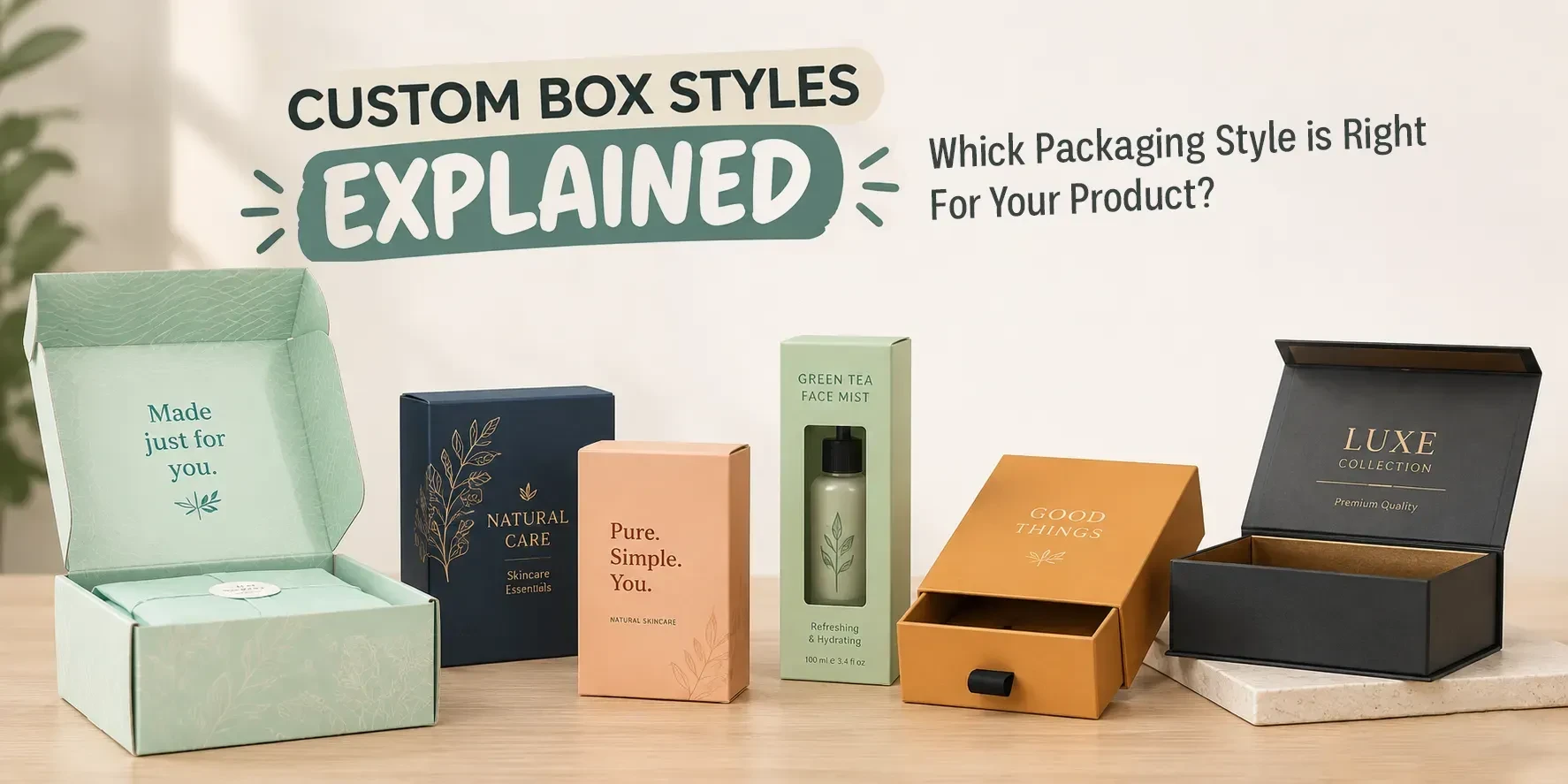
From custom tuck boxes and pillow boxes to drawer boxes and printed window boxes, each style is made with a particular structure and purpose in mind. Some are ideal for lightweight retail products, while others are suitable for premium items, gifts, food items, or products that need additional support.
With so many options available, choosing the right style can sometimes be confusing.
Right?
In this guide, we will explore popular custom box styles and explain which products they are best suited for.
Key Takeaways!
- Choose a box style based on the product’s size, weight, quantity, and shipping needs.
- Tuck, auto-lock, snap-lock, sleeve, drawer, and magnetic boxes suit different products and uses.
- Consider the opening style in terms of convenience and customer access.
- Inserts, dividers, and cutouts can keep products secure and separated.
- Multiple products and gift sets may require different interior arrangements.
- The best style is the one that fits the product without adding unnecessary features or cost.
Why Does the Right Custom Box Style Matter? A Real Fact
A box can look attractive, but if its structure does not suit the product, it may create problems during packing, handling, or storage. This is why choosing the right box style matters from the start.
The structure determines how the product fits inside, how the box closes, and how easily it can be packed. Some styles provide quick assembly, while others offer a stronger closure or make the product easier to access. The available storage space and shipping requirements can also affect this choice.
For example, a box with a strong base can be useful for heavier products, while a style with a simple opening can make packing and unpacking quicker. By matching the box structure with the product’s requirements, businesses can avoid unnecessary packaging issues.
“When the Box Suits the Product, Every Part of the Packaging Works Better.”
Comparison of Popular Custom Box Styles - Understand Their Uses Across Different Products
With so many box styles available, businesses can choose packaging according to the type of product they sell. Here are some commonly used custom box styles and the products they can suit.
Tuck-Style Packaging
With flaps that fold into the package, tuck packaging provides a simple closure for products that need easy access. Custom tuck boxes are commonly used for playing cards, stationery, tea packs, soap bars, small electronics, and pharmaceutical products.
Auto-Lock Construction
An auto lock box features a base that folds and locks in place during assembly. This structure can save packing time while keeping the bottom securely closed. It is a suitable choice for products such as shoes, confectionery, household items, and subscription products.
Snap-Lock Packaging
A snap lock design keeps the bottom firmly closed through interlocking tabs. This makes custom snap lock boxes a useful option for items that may put more weight on the base, such as glass bottles, hardware pieces, accessories, and gift products.
Sleeve-Style Boxes
Instead of opening from a flap, custom sleeve boxes use a sliding inner tray covered by an outer sleeve. This gives the package a different opening method while providing two surfaces for printed artwork. Cosmetics, candles, chocolates, and gift sets are some of the products that can be packed in these boxes.
Drawer Style Boxes
Rather than lifting a lid, customers pull the inner section outward to reveal the contents. This makes drawer boxes useful when several small pieces need to be arranged inside one package. Jewelry, perfume sets, stationery collections, premium chocolates, and small accessories are some suitable applications for custom drawer boxes.
Magnetic Closure Boxes
Hidden magnets in the lid and base keep the box securely closed. There are no visible locking tabs, giving the box a clean opening and closing method. Custom magnetic closure boxes are often selected for watches, jewelry, branded accessories, and special gift sets.
Custom Shipping Mailers
Built for direct delivery, mailer boxes combine folding panels with locking flaps to keep the package closed during shipment. The structure of custom mailer boxes is especially useful for online orders, subscription kits, books, apparel, handmade products, and electronic accessories.
Key Considerations Before Choosing the Right Customized Box Packaging Style
- Start with the Product Dimensions
Measure the product from every side, especially if it has an unusual shape or comes with multiple pieces. It is also important to understand how its length, width, and height affect the size of the box you need.
If you are unsure how length, width, and height are used to determine packaging dimensions, you can read our “Custom Packaging Dimensions: Length, Width & Height Explained” guide for a clearer understanding before selecting your box size.
The box should leave enough room for the contents and any inserts without becoming unnecessarily large.
- Measure the Weight of the Product
A small product can still be heavy. Glass bottles, metal accessories, tools, and similar items may require a stronger base than lightweight goods. In such cases, the box structure and board thickness should be considered together.
- Decide How You Want the Box to Open
Do you want customers to lift a lid, pull out a tray, unfold a flap, or open a magnetic closure? This simple decision can immediately remove several unsuitable styles from your list.
- Think About Its Destination
A package going onto a retail shelf has different requirements from one traveling through an e-commerce delivery network. Consider stacking, handling, storage space, and how the package will reach the customer.
- Finally, Keep the Budget in View
Not every product needs a detailed structure. A straightforward style may be enough for everyday goods, while premium products can benefit from additional components such as inserts, magnetic closures, or specialty finishes.
The best choice is usually the one that meets the product's actual requirements without adding features that are not needed.
Consider How Custom Features Can Make Unique Box Styles More Attractive to Customers
A distinctive box style can become more appealing when additional features are selected to complement its structure. These details can give customers a more interesting presentation and make the package look more suited to the product inside.
Some options include:
- Custom Inserts: Designed specifically for the product, inserts can create a space for each item and prevent unnecessary movement inside the box.
- Dividers: Useful when several products or components are packed together, dividers keep each piece separated and organized.
- Molded Inserts: These can be shaped around individual products to provide a closer fit, making them suitable for items that need additional support.
- Product Trays: Trays can give products a defined position inside a drawer, sleeve, or two-piece style while making the contents easier to arrange.
- Custom Cutouts: Specific sections can be cut according to the product's shape, allowing it to remain in a fixed position inside the package.
These additions can make the package look more complete, distinctive, and suitable for its intended product. When customers open a box and find each component presented in its own place, the packaging can communicate greater attention to detail and make the product presentation more impressive.
How Packaging Box Styles Can Adapt to Different Product Quantities and Sets
The number of products going inside a box can change the packaging requirements. A style that works for one item may need some adjustments when several products, accessories, or components are packed together. The idea is to create enough room for everything while keeping the package easy to handle and present.
For a single product, the box can be planned around its size and shape, with additional space for any protective elements. When multiple items are included, the interior may need a different arrangement to keep everything in its position.
Determine How Many Items the Box Can Hold
Before finalizing the structure, consider whether the package will contain:
- One main product
- Several units of the same product
- A main item with accessories
- Products of different sizes
- A complete gift or product collection
For example, a skincare brand may sell a set containing a cleanser, serum, and moisturizer. Instead of placing all three products loosely inside one large box, the packaging can include separate sections or fitted inserts for each item. This keeps the set together while giving the contents a more organized presentation.
Gift sets and custom subscription boxes can require even more flexibility because their contents may vary. A box that can accommodate different combinations can be useful when products are changed seasonally or updated for different collections.
The same idea applies to product bundles. A box style does not necessarily have to remain limited to one item. With the right dimensions and interior additions, it can be adapted for several products while maintaining the overall appearance of the packaging.
Align Your Box Style with Your Product, Brand Image, and Customer Needs
By now, you have seen that every box style has its own structure and purpose. The easiest way to narrow down your options is to look at your product, how it will be sold, and the type of presentation you want to create.
Here is a quick concluding table to help you compare the key points before making your choice:
If You’re Looking For | Styles to Consider |
Easy packing and access | Tuck-style boxes |
Added base security | Auto-lock or snap-lock styles |
A sliding opening | Sleeve or drawer boxes |
A more distinctive presentation | Drawer or magnetic styles |
Separate product sections | Inserts or divider-equipped boxes |
Shipping-friendly packaging | Mailer boxes |
A premium presentation | Rigid or magnetic box styles |
Concluding Remarks!
There is no single box style that works for every product. The better choice comes from matching the structure to what you are selling, how many pieces it holds, how it will be handled, and how you want customers to open it. A simple tuck box can suit everyday products, while drawer, magnetic, or fitted styles can work better for sets and higher-end items.
Before settling on a structure, compare the available options against your product requirements rather than choosing based on appearance alone. If you are confused between different styles, BoxLark can help you compare them and select a suitable structure. Reach out at sales@boxlark.com to discuss your requirements.