


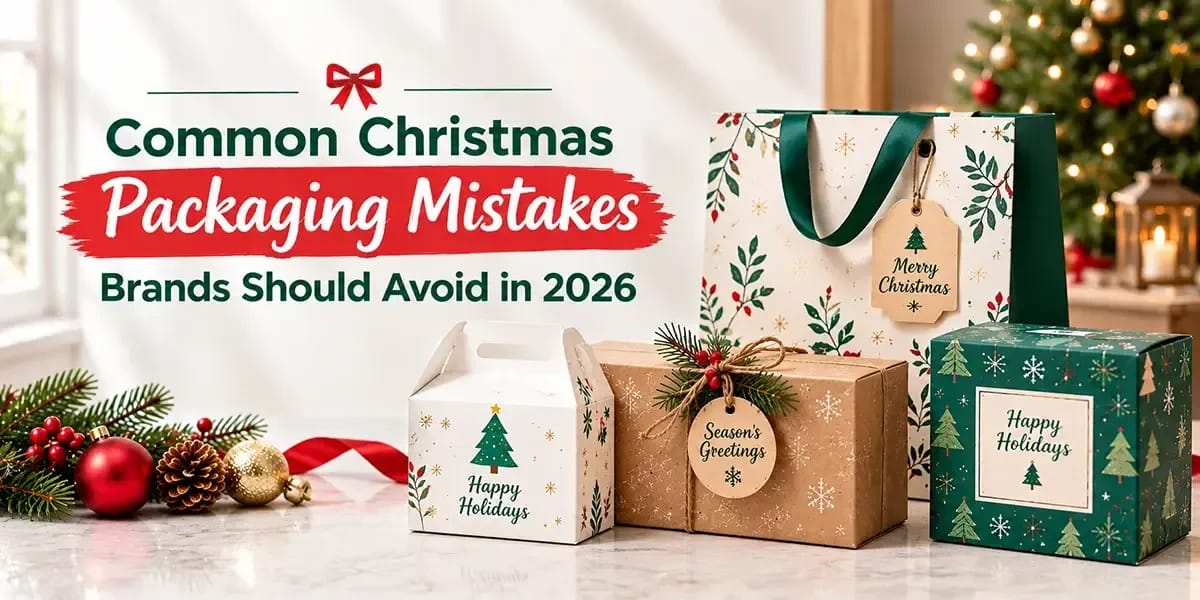
Common Christmas Packaging Mistakes Brands Should Avoid in 2026
Discover how premium packaging transforms your brand's perception and drives customer loyalty in today's competitive market.
- Key Takeaways!
- 1. Ignoring Current Packaging Requirements While Focusing Too Much on Christmas Design
- 2. Covering Holiday Packaging with Extra Festive Elements and Making the Brand Harder to Recognize
- 3. Choosing Christmas Packaging Before Checking the Size, Shape, and Protection Needs of the Products
- 4. Waiting Long Enough to Approve Christmas Packaging and Leaving Too Little Time for Production
- 5. Choosing Materials Without Checking Their Recycling Options
- 6. Making Holiday Packaging Hard to Open by Prioritizing Design Over Ease of Use
- 7. Ordering Christmas Packaging Without Estimating How Much You Will Need
- Final Considerations for Christmas Packaging in 2026
The packaging for Christmas is under more pressure compared to any other form of seasonal packaging because it has to meet a number of criteria in addition to having a festive look. These include issues of manufacture, transportation, usage, and disposal of the package. This will be especially apparent in 2026 due to changes in regulations in relation to packaging, recycling, availability, and deadlines for deliveries. Although the packaging looks marvelous in the advertisement of the product, there would still be problems with the packaging.
This guide looks at the common Christmas packaging mistakes brands should avoid in 2026, from choosing materials and box sizes to managing production timelines and seasonal quantities. The goal is not to remove the festive character from packaging, but to help brands make better decisions before production begins. Reviewing these details early can prevent unnecessary material use, rushed orders, damaged products, and customer frustrations during one of the busiest times of the year.
Let’s look at these common mistakes one by one!
Key Takeaways!
- Check the latest requirements before finalizing your Christmas packaging, including rules for materials, recycling, labeling, and environmental claims.
- Keep festive graphics connected to the brand so Christmas elements do not make the original identity difficult to recognize.
- Determine the right packaging structure by considering the product’s size, shape, weight, fragility, and protection needs.
- Submit your artwork early to allow enough time for approval, sampling, production, shipping, and any last-minute changes before the holiday rush.
- Do not rely on sustainability labels alone; consider the complete package, including materials, coatings, inserts, and other components.
- Test the finished package before production to make sure it is easy to open and allows customers to access the contents without unnecessary difficulty.
- Estimate Christmas packaging quantities carefully to avoid running short or being left with excess seasonal stock after the holidays.
1. Ignoring Current Packaging Requirements While Focusing Too Much on Christmas Design
Many brands begin their Christmas packaging by choosing festive colors, patterns, messages, and finishing details. They often check the material, recycling, and labeling requirements only after the design has been approved. If the approved design does not meet those requirements, changes may be needed before production, which can add extra work and delay the order.
A common mistake is approving the artwork first and checking these requirements afterward. Instead, brands should review the packaging requirements at the planning stage.
Before approving the packaging, check:
→ Where the packaging will be sold
→ What materials are being used
→ Whether the packaging meets applicable recyclability requirements
→ Which labeling information is required
→ Whether any environmental claims can be supported
Checking these points before printing can prevent last-minute artwork changes and unnecessary reprints during the busy holiday season.
2. Covering Holiday Packaging with Extra Festive Elements and Making the Brand Harder to Recognize
Some brands add so many Christmas-themed elements that their regular branding gets lost in the seasonal design. Snowflakes, trees, stars, ornaments, ribbons, seasonal characters, multiple colors, and different typefaces can make the original brand difficult to recognize.
For a few ideas on combining Christmas graphics and other festive details, you may read “Christmas Packaging for Gifts: Creative Ideas to Spread Holiday Cheer”.
The problem is not using Christmas elements. The problem starts when every available space is filled with them.
A better approach is to keep the main brand elements familiar and add Christmas details in selected areas.
Keep these elements connected:
- Logo: Maintain its familiar position and size
- Brand colors: Add seasonal shades without replacing the main palette
- Typography: Avoid adding several decorative fonts
- Christmas graphics: Use one or two clear themes
- Product information: Keep it easy to find
For example, a bakery that normally uses a simple cream-and-brown bakery box does not need to replace its entire design with red, green, gold, snowflakes, and Christmas characters. A small seasonal pattern or holiday message can create the same connection while allowing customers to recognize the brand.
The goal is to make the package look Christmas-ready without making it look like a completely different brand.
3. Choosing Christmas Packaging Before Checking the Size, Shape, and Protection Needs of the Products
Some brands decide on Holiday packaging before taking a close look at the item that will go inside it. That can cause trouble when the product is heavy, fragile, of an unusual shape, or sold as part of a set.
Packaging may look suitable on the outside but leave the item moving around inside, putting pressure on certain areas and ruining the brand reputation.
The product and bag or box should be compared before the seasonal design is finalized.
Product Factor | What to Check |
Size | Measure the item's length, width, and height |
Weight | Make sure the chosen packaging style can safely contain the product |
Shape | Allow room for corners, curves, handles, or other raised parts |
Fragility | See if an insert or divider is needed |
Gift sets | Leave room to separate individual pieces |
A Few Checks Before Ordering the Christmas Box
→ Measure the item rather than estimating its size
→ Leave room where the product needs protection
→ Check whether an insert, divider, or tray is needed
→ Make sure the item can be placed inside without force
→ Test one packed sample before ordering in bulk
For instance, a glass candle may need a fitted custom candle box with an insert, while folded clothing can sit comfortably in a simpler box. A Christmas gift set containing several jars, bottles, or small products may need separate sections to stop the pieces from hitting into each other.
“The Festive Design Should Fit the Package, Not Have the Packaging Follow the Design.”
Once the item's size and protection needs are clear, the box or custom bag style, print, and finishing can be decided afterward.
4. Waiting Long Enough to Approve Christmas Packaging and Leaving Too Little Time for Production
One of the most frequent Holiday packaging mistakes is assuming there will always be enough time to place an order later. Once the holiday season gets closer, there may be artwork changes, sample corrections, printing, finishing, packing, and shipping to deal with. A delay at any one point can affect everything that comes after it.
A good way to avoid this is to plan ahead based on the date you need the finished boxes in stock.
Think of your Christmas packaging order as a chain:
Artwork → Sample → Approval → Production → Delivery → Stock
If one link is delayed, the next one has to wait.
For example, changing the box size after the sample has already been approved may mean producing another sample. Adding foil, embossing, or a special coating at the last minute can also change the production schedule.
Leave Some Extra Time in Your Schedule
Before placing the order, write down three dates:
- Artwork approval date
The date by which all design changes should be finished. - Production deadline
The latest date the packaging should be ready for shipping. - Stock-ready date
The date when the packaging must actually be available for Christmas orders.
Keeping these dates separate makes it easier to spot a delay early. It also prevents the common situation where packaging arrives just days before the holiday rush, leaving no time to deal with an unexpected problem.
5. Choosing Materials Without Checking Their Recycling Options
Using a material with a sustainable-sounding name does not automatically make the whole package easy to recycle. A Christmas box can be made mainly from paperboard and still contain other parts, coatings, foils, glitter, windows, or mixed materials that make recycling more difficult.
Before choosing the material, brands should look at the complete package, not just the outer box. Such as, a paperboard box may seem like a simple recyclable choice, but adding a plastic window, heavy coating, mixed-material insert, or other components can change the way the package is handled after use. Christmas packaging can also include decorative elements that add materials without serving a useful purpose.
Ask These Questions Before Choosing the Material
What material will the box be made from?
Know the actual board or paper type instead of relying on a general sustainability label.
What additions will the box have?
Look at windows, inserts, coatings, foils, adhesives, and other parts.
What happens after use?
Check whether the complete package fits the recycling system available to the customer.
Can the claim be supported?
If the package is marketed as recyclable or environmentally responsible, the claim should be based on the complete package rather than one material alone.
Choosing a suitable material starts with considering every part of the package, not simply the most appealing sustainability term in a supplier's description.
6. Making Holiday Packaging Hard to Open by Prioritizing Design Over Ease of Use
Christmas packaging is often designed to create a special opening moment, but adding too many folds, layers, tapes, ties, or tightly sealed parts can make that moment frustrating. This becomes more noticeable when the package is being opened by children, older adults, or anyone with limited hand strength or movement. Accessibility guidance for 2026 packaging design places attention on factors such as opening force, grip, clear opening points, and reducing unnecessary actions.
Test the Package Before Final Approval
Before approving the final package, give a sample to someone who has not seen it before. Watch how they try to open it and note where they hesitate or need help.
Look → Do they quickly see where to open it?
Grip → Can they find an easy place to hold it?
Pull → Does it require too much force?
Remove → Can the product come out without getting stuck?
If the person needs scissors, a knife, or several attempts to figure out the opening, the package may need another look.
Follow these small changes that can make a difference:
- Use a clearly visible opening tab where needed.
- Avoid excessive adhesive or unnecessary layers.
- Keep important instructions readable.
- Give the user enough space to grip the box or opening point.
- Test the package with the actual product inside, not as an empty sample.
7. Ordering Christmas Packaging Without Estimating How Much You Will Need
Planning for only one expected quantity can cause problems when holiday demand changes. If demand is higher than expected, the packaging may run out before the season ends. If demand is lower, extra Holiday packaging may be left in storage after the season, especially when it has dates, greetings, or other seasonal details that cannot be used again.
Two Problems Can Come From the Same Ordering Decision
Packaging Shortage:
A shortage can force the brand to place a small emergency order, switch to another package, or use non-seasonal bags and box packaging for the remaining orders.
Packaging Left Over:
Excess seasonal stock can take up storage space and may have limited use once Christmas is over.
A better quantity estimate should look at more than the expected holiday volume. Review the previous holiday period, current order patterns, planned promotions, and any new products that will use the seasonal packaging. It is also useful to separate packaging that can be reused throughout the year from packaging that is strictly Christmas-specific.
For example, a plain printed box with a removable holiday-designed sleeve may have another use after December, while a box covered with a Christmas 2026 message may have very little value once the season ends.
- Solution: Before confirming the final quantity, compare the expected requirement with previous seasonal demand and consider how much packaging could still be used if sales differ from your estimate.
- Result: This makes seasonal ordering less dependent on one estimate. It also reduces the chance of having too little packaging or a large amount of unused Holiday packaging.
Final Considerations for Christmas Packaging in 2026
Christmas packaging needs more than a festive design because several details can affect how well the package performs during the holiday season. Brands need to consider current packaging requirements, product size, production schedules, material choices, ease of opening, and the quantity they are likely to need before placing an order.
Reviewing these details early gives brands time to test the packaging choices, make design adjustments, confirm materials, and revise the required quantity before production starts.
Taking these factors into account from the beginning can help ensure that the final package suits the product, works well for customers, and still carries the Christmas character expected during the holiday season.
For brands preparing seasonal boxes with a custom packaging manufacturer such as BoxLark, sorting out these details early makes it easier to confirm the right box specifications and production needs before the holiday rush. For help with your custom bags, boxes, add-ons, specifications, or any other packaging needs, you can contact sales@boxlark.com.